Measuring Progress Toward Accountable Care
Join Patrick Falvey, PhD, Executive Vice President and Chief Integration Officer at Aurora Health Care, for a comprehensive webinar on the readiness of Aurora Health Care's accountable care initiatives. Discover the organization’s integrated approach across 31 counties, 15 hospitals, and over 1,500 employed physicians, as well as their focus on improving quality and efficiency through innovative partnerships. Gain insights into effective care redesign, patient-centered strategies, and the essential factors that differentiate organizations ready for successful accountable care.

Measuring Progress Toward Accountable Care
E N D
Presentation Transcript
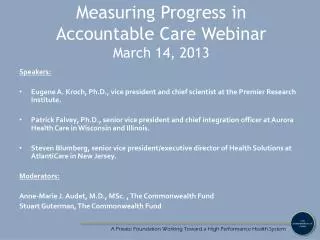
Measuring Progress Toward Accountable Care Aurora Health Care Readiness to Implementation Patrick Falvey, PhD Executive Vice President/ Chief Integration Officer Aurora Health Care Milwaukee, Wisconsin The Commonwealth Fund Webinar March 14, 2013
Aurora at a Glance • Private, not-for-profit integrated health care provider • 31 counties, 90 communities • 15 hospitals • 172 clinics sites • More than 1,500 employed physicians • Largest homecare organization in the state • More than 70 retail pharmacies • 30,000 caregivers • 94,000 inpatient discharges • 2 million outpatient visits • 4.1 million ambulatory care visits • Revenues greater than $4.2 billion
Focused Populations Aurora Caregivers and Beneficiaries • 50,000 Lives • 15 years of better-than-market performance • Top-tier quality performance Shared Savings ACO • CMS Model 1 Demonstration • About 10,000 Beneficiaries • Improved Quality and Efficiency Aurora Accountable Care Network • Commercial market ACO • Partnership with Aetna • Partnership with Anthem Medicaid Program • Medicaid OB pilot Care Redesign Pilots • Behavioral Health • Orthopedics • Nursing Home • Kenosha ACO
Transforming Towards Accountable Care Accountable care infrastructure Patient-centered continuum of care Care redesign tactics Communication & EHR Payer partnerships Network Interconnectivity Patient Populations Operational Efficiency Patient/Family engagement Health home Legal Clinical knowledge management Risk Assessment minimization Public policy Measurement Population benefits & data management
Factors That Differentiate Organizations with High ACO Readiness • Full or partial ownership of a health plan with population health management capabilities • Existing collaboration with other health systems in the community • Existing risk-based contracts with payers including bundled payments • A sophisticated EHR and HIE implementation strategy across the continuum of care • Clinical integration across the continuum of care • Patient-centered medical home with employed or community providers • Positive relationships with primary care and specialty care providers in the market • Active governance structures that include physician leadership (e.g. PHOs)
Positive Physician Relationships • Accountable Care/Care Redesign Medical Group Leadership • Care Redesign Around Primary Care, Clinical Integration, Smart Chart, Clinical Programs, and Redesign Pilots • Patient-Centered Medical Home • Physician Compensation Collaborative
Factors Likely to Become Differentiators in More Mature Models • Active governance structures that include physician leadership (e.g. PHOs) • An EHR and HIE implementation strategy across the continuum of care • Physician leadership development programs or culture barriers • Payers that are initiating innovative risk-based relationships
Organizational Relationships • Smart Chart Implementation to Transformation • ACO Governance • Administrators and Physician Leadership Development • Medical Group Leadership Council • Payer–Provider Role Definition
Population Health Analytics • Quality and Efficiency Metrics • Registries—Leverage EHR • Clinical and Financial Analytics • Patient Risk Models, ETGs
Moving Forward • Accountable Care Infrastructure • Care Redesign Tactics • Network Development • Payer Partnership • Analytics