1.5 Solving Linear Inequalities
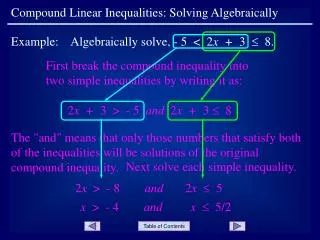
This guide covers the essentials of solving linear inequalities, focusing on symbols like less than, greater than, and their variations. Learn how to determine solutions for inequalities in one variable, such as (2x - 3 < 8). Understand the principles of manipulating inequalities, such as adding or subtracting the same number on both sides, and the crucial rule of flipping the inequality sign when multiplying or dividing by a negative number. Explore various graphing techniques and compound inequalities to visualize solutions effectively.

1.5 Solving Linear Inequalities
E N D
Presentation Transcript
Inequality Symbols Less than Not equal to Less than or equal to Greater than or equal to Greater than
Inequality with one variable to the first power. for example: 2x-3<8 • A solution is a value of the variable that makes the inequality true. x could equal -3, 0, 1, etc. Linear Inequality
Add/subtract the same number on each side of an inequality • Multiply/divide by the same positive number on each side of an inequality • If you multiply or divide by a negative number, you MUSTflip the inequality sign! Transformations for Inequalities
Ex: Solve the inequality. 2x-3<8 +3 +3 2x<11 2 2 x< Flip the sign after dividing by the -3!
Remember: < and > signs will have an open dot o and signs will have a closed dot graph of graph of Graphing Linear Inequalities 4 5 6 7 -3 -2 -1 0
An inequality joined by “and” or “or”. Examples “and” “or” think between think oars on a boat Compound Inequality -3 -2 -1 0 1 2 3 4 5 -4 -3 -2 -1 0 1 2
-9 < t+4 < 10 -13 < t < 6 Think between! Example: Solve & graph. -13 6
-6x+9 < 3 or -3x-8 > 13 -6x < -6 -3x > 21 x > 1 or x < -7 Flip signs Think oars Last example! Solve & graph. -7 1