Binomial Heaps and Trees for Efficient Memory Allocation
Explore the concept of binomial heaps and trees for efficient memory allocation in classes, covering properties, union operations, implementation details, and proof of properties. Learn about insertions, deletions, min extraction, and more.

Binomial Heaps and Trees for Efficient Memory Allocation
E N D
Presentation Transcript
Binomial Heaps Jyh-Shing Roger Jang (張智星) CSIE Dept, National Taiwan University
Memory Allocation in Classes • The binary heap is good for simple operations such as insertion, deletion, and min extraction, but it is bad for union operation. • Union operation requires building up a new heap from scratch using the elements from the old heaps, which is expensive • Binomial heaps support union operations more efficiently.
Binomial Trees • A binomial heap is a collection of binomial trees • A binomial tree Bk is an ordered tree defined recursively • B0 consists of a single node • Bk consists of two binomial tree Bk-1, with root of one is the leftmost child of the root of the other
Properties of Binomial Trees • For a binomial tree Bk • There are 2k nodes • Height = k • Degree of root = k • There are exactly nodes at depth i for i = 0, 1, …, k • The root has a k subtrees, with each subtree being Bi with i = k-1, k-2, …, 0. Deleting root yields binomial trees Bk-1, Bk-2, …, B0 . Proof by induction on k
Binomial Heap • Binomial heap by Vuillemin, 1978 • Composed of a sequence of binomial trees • Each tree is min-heap ordered • 0 or 1 binomial tree of order k
Binomial Heap: Implementation • Common implementation of binomial heaps • Represent trees via left-child, right-sibling pointers • Three links per node: parent, left, right • Roots of trees connected with singly linked list • Degrees of trees strictly decreasing from left to right
Binomial Heap: Properties • Properties of N-node binomial heap • Min key contained in roots of Bk-1, Bk-2, …, B0 • Contains Bi if bi=1 for binary representation bk-1bk-2…b2b0. • At most binomial trees • Height ≤
Binomial Heap: Proof of Properties • Properties of N-node binomial heap • Assume its binary representation is bk-1bk-2…b1b0, with bk-1 ≠ 0 • At most binomial trees • Height = k-1 ≤ 100…0 111…1
Binomial Heap: Union of Same-order Binomial Trees • Create Binomial Tree H that is union of H’ and H’’ • Easy if H’ and H’’ are of the same order (degree) • Connect roots of H’ and H’’, with smaller key to be root of H • Choose smaller Min key contained in roots of Bk-1, Bk-2, …, B0 Keep min-heap order
Binomial Heap: Union • Union of two binomial heaps • Reference: http://www.cs.princeton.edu/~wayne/cs423/lectures/heaps.ppt Just like adding two binary numbers
Binomial Heap: Union 6 3 18 37 8 29 10 44 30 23 22 48 31 17 15 7 12 45 32 24 50 25 28 33 + 55 41
Binomial Heap: Union 12 18 6 3 18 37 8 29 10 44 30 23 22 48 31 17 15 7 12 45 32 24 50 25 28 33 + 55 41
3 12 18 7 37 25 6 3 18 37 8 29 10 44 30 23 22 48 31 17 15 7 12 45 32 24 50 25 28 33 + 55 41 12 18
3 3 12 18 15 7 7 37 37 28 33 25 25 41 6 3 18 37 8 29 10 44 30 23 22 48 31 17 15 7 12 45 32 24 50 25 28 33 + 55 41 12 18
3 3 12 18 15 7 7 37 37 28 33 25 25 41 6 3 18 37 8 29 10 44 30 23 22 48 31 17 15 7 12 45 32 24 50 25 28 33 + 55 41 3 12 15 7 37 18 28 33 25 41
3 3 12 18 15 7 7 37 37 28 33 25 25 41 6 3 18 37 8 29 10 44 30 23 22 48 31 17 15 7 12 45 32 24 50 25 28 33 + 55 41 6 3 12 8 29 10 15 7 44 37 18 30 23 22 48 31 17 28 33 25 45 32 24 50 41 55
Binomial Heap: Union • Create heap H that is union of heaps H' and H''. • Analogous to binary addition. • Running time. O(log N) • Proportional to number of trees in root lists 1 1 1 1 0 0 1 1 + 0 0 1 1 1 19 + 7 = 26 1 1 0 1 0
Binomial Heap: Delete Min 3 6 18 44 8 29 10 37 30 23 22 48 31 17 H 45 32 24 50 55 • Delete node with minimum key in binomial heap H. • Find root x with min key in root list of H, and delete • H' broken binomial trees • H Union(H', H) • Running time. O(log N) Comparison: O(1) for finding min if we always keep a pointer to the min
Binomial Heap: Delete Min H' • Delete node with minimum key in binomial heap H. • Find root x with min key in root list of H, and delete • H' broken binomial trees • H Union(H', H) • Running time. O(log N) 6 18 44 8 29 10 37 30 23 22 48 31 17 H 45 32 24 50 55
Binomial Heap: Decrease Key • Decrease key of node x in binomial heap H. • Suppose x is in binomial tree Bk. • Bubble node x up the tree if x is too small. • Running time. O(log N) • Proportional to depth of node x log2 N . 3 6 18 depth = 3 44 8 29 10 37 30 23 22 48 31 17 H x 32 24 50 55
Binomial Heap: Delete • Delete node x in binomial heap H. • Decrease key of x to -. • Bubble up to the root. • Delete min. • Running time. O(log N)
Binomial Heap: Insert • Insert a new node x into binomial heap H. • H' MakeHeap(x) • H Union(H', H) • Running time. O(log N) 3 6 18 x 44 8 29 10 37 30 23 22 48 31 17 H H' 45 32 24 50 55
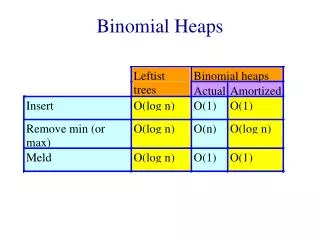
Binomial Heap: Sequence of Inserts • Insert a new node x into binomial heap H. • If N = .......0, then only 1 steps. • If N = ......01, then only 2 steps. • If N = .....011, then only 3 steps. • If N = ....0111, then only 4 steps. • Inserting 1 item can take (log N) time. • If N = 11...111, then log2 N steps. • But, inserting sequence of N items takes O(N) time! • (N/2)(1) + (N/4)(2) + (N/8)(3) + . . . 2N • Amortized analysis. • Basis for getting most operationsdown to constant time. 3 6 x 37 29 10 44 48 31 17 50
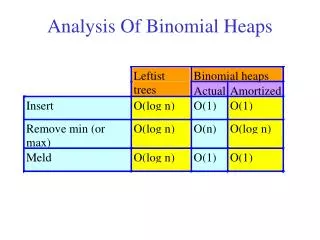
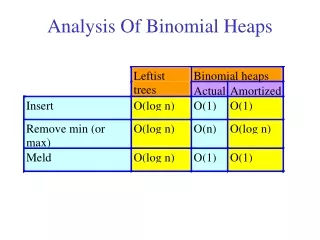
Priority Queues With extra book keeping Heaps Operation Linked List Binary Binomial Fibonacci * Relaxed make-heap 1 1 1 1 1 insert 1 log N log N 1 1 find-min N 1 1 1 1 delete-min N log N log N log N log N union 1 M*log(M+N) log N 1 1 decrease-key 1 log N log N 1 1 delete N log N log N log N log N is-empty 1 1 1 1 1 M is the size of the smaller heap just did this