
Gene Expression
E N D
Presentation Transcript
Early evidence indicating most genes specify the structure of proteins • Garrod’s work on inborn errors of metabolism in early 1900s • Beadle and Tatum’s work with Neurospora mutants in the 1940s
Mutationsaffectingbiochemical pathways
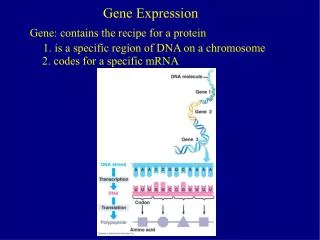
Information flow from DNA to protein • Transcription • RNA molecule complementary to the template DNA strand synthesized • Translation • Polypeptide chain specified by messenger RNA (mRNA) is synthesized
Structure of RNA • RNA • Formed from nucleotide subunits • Each nucleotide subunit contains ribose, a base, and three phosphates • Like DNA, RNA subunits are covalently joined by a 5΄—3΄ linkage to form alternating sugar-phosphate backbone
Transcription • Incoming nucleotides with three phosphates pair with complementary bases on the DNA strand • RNA polymerase cleaves two phosphates from each nucleotide and covalently links the remaining phosphate to the 3΄end of the RNA chain
Translation • Polypeptide chain specified by the mRNA is synthesized • Initiation • Repeating cycles of elongation • Termination • Each sequence of three nucleotide bases in the mRNA constitutes a codon • Requires tRNAs and cell machinery, including ribosomes
Coupled transcription and translation in bacteria • Unlike eukaryotic cells, in bacterial cells translation and transcription coupled • Translation of the bacterial mRNA molecule usually begins before the 3´ end of the transcript is completed
Retroviruses • Flow of genetic information is reversed by reverse transcriptase • Enzyme associated with retroviruses • Retroviruses synthesize DNA from an RNA template • Example of retrovirus is HIV-1, AIDS virus
Mutations • Base substitution mutations • Often result from errors in base pairing during replication • Missense mutations • Nonsense mutations • Frameshift mutations • One or two nucleotide pairs are inserted into or deleted from the molecule
Some mutations involve larger DNA segments • Due to change in chromosome structure • Wide range of effects as they involve many genes • DNA sequences that “jump” into the middle of a gene • Known as transposons or transposable genetic elements • Most are retrotransposons