Download
1 / 16
160 likes | 279 Vues
This document explores the fundamental aspects of scientific programming in the context of steady-state heat conduction. It begins with problem definition and physical mathematical formulation, focusing specifically on 1-D and 2-D scenarios. The text covers the development of computer code, logic assembly (flowcharts), code testing, troubleshooting, result visualization, and optimization. In addition, it discusses key concepts such as the Laplace equation and iterative methods for numerical solutions. This resource serves as an introductory guide for implementing heat conduction simulations in MATLAB.

E N D
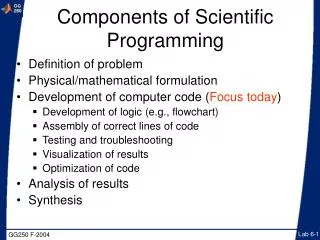
Components of Scientific Programming • Definition of problem • Physical/mathematical formulation (Focus today) • Development of computer code (Focus to date) • Development of logic (e.g., flowchart) • Assembly of correct lines of code • Testing and troubleshooting • Visualization of results • Optimization of code • Analysis of results • Synthesis
Steady-State Heat Conduction Equation Qin Qout dx In this exercise, no major Matlab concepts need to be implemented. The focus is on a small change in the coding and mathematics as a result of the physics extending from 1-D to 2-D.
Steady-State Heat Conduction Equation (1-D) Qin Qout Insulated wire or rod dx Change in thermal energy in time = Heat flow out - Heat-flow in T = temperature, and x = position We will represent dT/dx as T'. At steady state, the rate of energy change (E*) is zero:
Steady-State Heat Conduction Equation (1-D) Qin Qout dx At steady state,the rate of energy change (E*) is zero everywhere, so E* does not change as a function of position (x): This is the Laplace equation, one of the most important equations in physics
What does T" = 0 mean? • T' = constant • A plot of T vs. x must be a line. • T must vary linearly between any two points along the rod at steady state. • If T is known at positions xi-1 and xi+1, then T(i) = [T(i-1) + T(i+1) ]/2 • T(i) = average of Tat the nearby equidistant points (see Appendix for more detail) xi-2 xi-1 xi xi+1 xi+2
1-D Steady State Heat Conduction (a) num_iterations = 500; x = 1:50; T = 10.*rand(size(x)); % initial temperature distribution n = length(x); for j = 1:num_iterations % a "for loop" is used here for i=2:n-1; % Don't change T at the ends of the rod! T(i) = (T(i+1) + T(i-1))./2; end figure(1); clf; plot(x,T); axis([0 n 0 10]); xlabel('x'); ylabel('T'); end Interior Pt. Boundary Pt. with fixed boundary conditions Boundary Pt. with fixed boundary conditions x1 x2 xi x49 x50 i =1 i = 2 i = i i = 49 i = 50
1-D Steady State Heat Conduction (b) num_iterations = 500; x = 1:50; T = 10.*rand(size(x)); % initial temperature distribution n = length(x); for j = 1:num_iterations % a "for loop" is used here T(2:n-1) = (T (3:n) + T(1:n-2))./2; figure(1); clf; plot(x,T); axis([0 n 0 10]); xlabel('x'); ylabel('T'); end % Shorter, and it runs, but it introduces “noise” Interior Pt. Interior Pt. Boundary Pt. with fixed boundary conditions Boundary Pt. with fixed boundary conditions x1 x2 xi x49 x50 i =1 i = 2 i = i i = 49 i = 50
1-D Steady State Heat Conduction (c) x = 1:50; T = 10.*rand(size(x)); % initial temperature distribution n = length(x); tol = 0.1; dT = tol.*2.*ones(size(T)); % Initialize dT while max(abs(dT)) > tol % a "while loop" is used here for i=2:n-1 ; dT(i) = ((T(i+1) + T(i-1))./2) -T(i); % Change in T T(i) = T(i) + dT(i); % New T = old T + change in T end figure(1); clf; plot(x,T); axis([0 n 0 10]);figure(2) ; plot(x,dT); end % Hit ctrl-c to stop. Why won’t this stop? Interior Pt. Boundary Pt. with fixed boundary conditions Boundary Pt. with fixed boundary conditions x1 x2 xi x49 x50 i =1 i = 2 i = i i = 49 i = 50
1-D Steady State Heat Conduction (d) x = 1:50; T = 10.*rand(size(x)); % intial temperature distribution n = length(x); tol = 0.0001; dT = tol.*2.*ones(size(T)); % Initialize dT while max(abs(dT(2:n-1))) > tol % a "while loop" is used here for i=2:n-1 ; dT(i) = ((T(i+1) + T(i-1))./2) -T(i); % Change in T T(i) = T(i) + dT(i); % New T = old T + change in T end figure(1); clf; plot(x,T); axis([0 n 0 10]); xlabel('x'); ylabel('T'); end Interior Pt. Boundary Pt. with boundary conditions Boundary Pt. with boundary conditions x1 x2 x3 x4 x5 i =1 i = 2 i = 3 i = 4 i = 5
2-D Steady State Heat Conduction Equation For a 2-D problem, the temperature at a point is the average of T at the four nearest neighbors Boundary Condition (fixed) y5 y4 y3 y2 y1 Interior Point Note: grid is square Dx = Dy x1 x2 x3 x4 x5 x6 x7 x8 x9
2-D Steady State Heat Conduction Equation *Add a loop to account for 2-D grid *Reformulate T(xi) to account for 2-D *Check for convergence Boundary Condition (fixed) y5 y4 y3 y2 y1 Interior Point Note: grid is square Dx = Dy x1 x2 x3 x4 x5 x6 x7 x8 x9
Appendix • This appendix shows in more detail how the second derivative d2T/dx2 is evaluated numerically using a finite difference approximation method.
Solution of 1-D Steady State Heat Conduction Equation x-x x+(Dx)/2 x x+(Dx)/2 x+Dx
1-D Steady State Heat Conduction Equation x-2Dx x+Dx x x+Dx x+2Dx
1-D Steady State Heat Conduction Equation In words, what does this mean? xi-2 xi-1 xi xi+1 xi+2