Advanced Sketch Recognition: Algorithms, Implementation, and AI Techniques
This course offers a comprehensive analysis and implementation of various sketch recognition algorithms, including feature-based, vision-based, geometry-based, and timing-based methods. Additionally, it covers techniques to combine results across algorithms to enhance recognition accuracy using AI techniques, such as graphical models. Participants will learn to make their drawings come alive through practical exercises involving Rubine classification, covariance matrix computation, and the normalization of gesture features. Hands-on assignments ensure a solid grasp of the material and encourage the exploration of innovative features for improved recognition.

Advanced Sketch Recognition: Algorithms, Implementation, and AI Techniques
E N D
Presentation Transcript
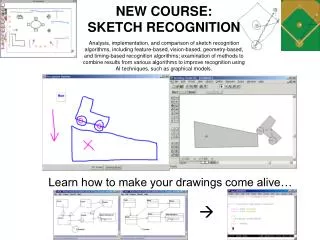
NEW COURSE: SKETCH RECOGNITION Analysis, implementation, and comparison of sketch recognition algorithms, including feature-based, vision-based, geometry-based, and timing-based recognition algorithms; examination of methods to combine results from various algorithms to improve recognition using AI techniques, such as graphical models. Learn how to make your drawings come alive…
Rubine Features • Make sure your to convert to double before dividing in Java • Remove the second point not the first for duplicate points • Try to get your values as close to mine and move on.
Rubine Classification • Evaluate each gesture 0 <= c <= C. • Vc = value = goodness of fit for that gesture c. • Pick the largest Vc , and return gesture c
Rubine Classification • Wc0 = initial weight of gesture • Wci = weight for the I’th feature • Fi = ith feature value • Sum the features together
Collect E examples of each gesture • (e should be 15 according to paper) • Calculate the feature vector for each example • Fcei = the feature value of the ith feature for the eth example of the cth gesture
Find average feature values for gesture • For each gesture, compute the average feature value for each feature • Fci is the average value for the ith feature for the cth gesture
Compute gesture covariance matrix • How are the features of the shape related to each other? • Look at one example - look at two features – how much does each feature differ from the mean – take the average for all examples – that is one spot in the matrix • http://mathworld.wolfram.com/Covariance.html • Is there a dependency (umbrellas/raining)
Normalize • cov(X) or cov(X,Y) normalizes by N-1, if N>1, where N is the number of observations. This makes cov(X) the best unbiased estimate of the covariance matrix if the observations are from a normal distribution.For N=1, cov normalizes by N • They don’t normalize for ease of next step (so just sum, not average)
Normalization • Taking the average • But… we want to find the true variance. • Note that our sample mean is not exactly the true mean. • By definition, our data is closer to the sample mean than the true mean • Thus the numerator is too small • So we reduce the denominator to compensate
Common Covariance Matrix • How are the features related between all the examples? • Top = non normalize total covariance • Bottom = normalization factor = total number of examples – total number of shapes = 26*14
Weights • Wcj = weight for the jth feature of the cth shape • Sum for each feature • Common Covariance Matrix inverted* ij • Average feature value for the ith feature for the cth gesture
Initial Weight • Initial gesture weight = • Sum for each feature in class: • Feature weight * average feature value
Rubine Classification • Evaluate each gesture 0 <= c <= C. • Vc = value = goodness of fit for that gesture c. • Pick the largest Vc , and return gesture c
Rubine Classification • Wc0 = initial weight of gesture • Wci = weight for the I’th feature • Fi = ith feature value • Sum the features together
Eliminate Jiggle • Any input point within 3 pixels of the previous point is discarded
Rejection Technique 1 • If the top two gestures are near to each other, reject. • Vi > Vj for all j != i • Reject if less than .95
Rejection Technique 2 • Mahalanobis distance • Number of standard deviations g is from the mean of its chosen class i.
Syllabus • http://www.cs.tamu.edu/faculty/hammond/courses/SR/2006
Homework • Fix covariance matrix • Implement trainer • Data: 26 gestures; 15 examples • Eij = Compute common covariance matrix (13*13) • Wci = Compute weights for each feature (26*13) • Wc0 = Compute initial weights for each class (26) • Build Classifier • Data: 2 gestures for each letter + 8 random = 60 examples • Vc = Compute value for each gesture • Classify with highest gesture number • Turn in: Code & classification and value for highest value • For Friday: Build option jitter reducer, rerun your data on the jitter reducer. Comment on any differences. • For Friday: Implement rejection • For Friday: Read Chris Long paper • For Monday: Come up with your own features. Compare your results.