Download
1 / 11
110 likes | 222 Vues
This guide delves into the concept of participles in English, highlighting their various forms such as the Present Active, Perfect Passive, Future Active, and Future Passive participles. Each type is explained clearly, focusing on how they relate to the main verb's action and their grammatical functions. The article will cover tense, voice, and how participles modify nouns while agreeing in case, number, and gender. Examples will illustrate usage to aid understanding. Perfect for students of grammar wanting to enhance their knowledge of participles.

E N D
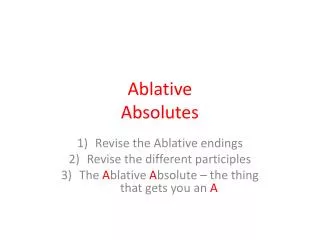
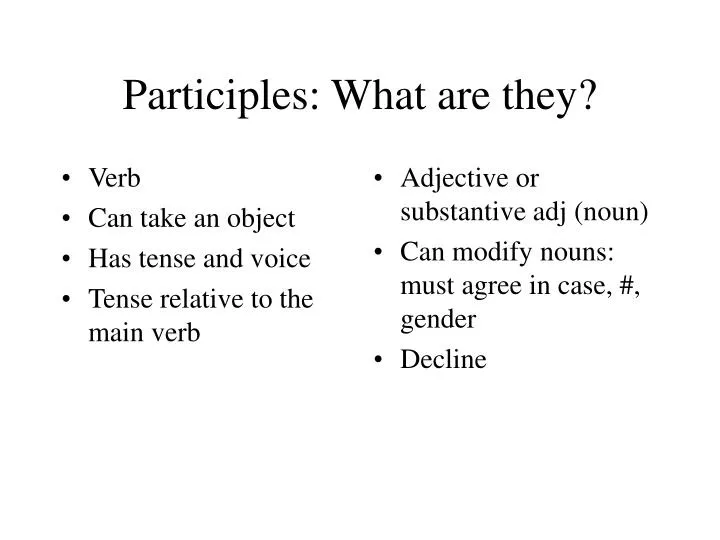
Verb Can take an object Has tense and voice Tense relative to the main verb Adjective or substantive adj (noun) Can modify nouns: must agree in case, #, gender Decline Participles: What are they?
Various participles in English • Running • run, having been run • About, going to run • About to be run, deserving/ fit to be run
Present Active Participle • Declines like a 3rd declension, two ending adjective • In the ablative singular: can end –e or –i (see Wheelock footenote p148) • Expresses action at the same time as the main verb • Translates as: verb -ing
Perfect Passive Participle • The fourth principal part • Declines like a 1-2 declension adjective • Expresses actions prior to that of the main verb • Translates as: having been verb-ed
Future Active Participle • 4th principal part + -urus, a, um • Declines like a 1-2 declension adjective • Expresses action after the main verb • Translates as: about/going to verb
Future Passive Participle • Formed off of present stem +undus, a, um • Declines as a 1-2 declension adjective • Expresses action after main verb • Translates as: deserving/fit to be verb-ed Or about to be _______ed
Loving the girl, • The poet writes a letter to her. • The poet wrote a letter to her. • The poet will write a letter to her.
Amans puellam, • Poeta scibit litteras ei. • Poeta scripsit litteras ei. • Poeta scribet litteras ei.
Having loved the girl, • The poet writes a letter to her. • The poet wrote a letter to her. • The poet will write a letter to her.
Amatus puellam, • Poeta scibit litteras ei. • Poeta scripsit litteras ei. • Poeta scribet litteras ei.