Understanding Geography: Continents, Oceans, and Map Skills for Students
This educational resource provides students with essential geographic skills, focusing on continents, oceans, hemispheres, and the use of maps and globes. Students will learn to identify and locate major physical and political features and understand latitude and longitude systems. They'll explore concepts like hemispheres and directions while employing tools like compass roses and map keys to interpret maps accurately. This foundational knowledge empowers students to acquire, process, and report information from a spatial perspective, enhancing their understanding of the world.

Understanding Geography: Continents, Oceans, and Map Skills for Students
E N D
Presentation Transcript
Geography Basic Skills – continents, oceans, hemispheres, latitude, longitude, directions
The student will: • Understand how to use maps, globes, and other geographic representations, tools, and technologies to acquire, process and report information from a spatial perspective. • Demonstrate how to identify and locate major physical and political features on globes and maps.
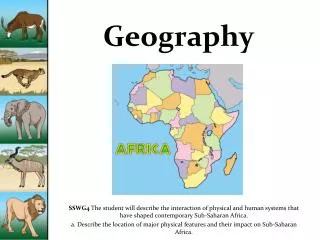
Continents • Earth has seven continents, or large bodies of land. • They are: Africa, Antarctica, Asia, Australia/Oceania, Europe, North America, and South America.
Oceans • Earth has five oceans, or large bodies of water. • The oceans are the: Atlantic, Arctic, Indian, Pacific, and Southern.
Hemisphere • Like Earth, globes are spheres. A sphere is an object shaped like a ball. At any one time, you see only one half of a globe. • Another word for half a sphere or globe is hemisphere. “Hemi” means half. • Earth can be divided into 4 hemispheres.
Hemisphere • The equator is an imaginary line running halfway between the North Pole and the South Pole. • The equator divides the globe into the Northern Hemisphere and the Southern Hemisphere.
Hemisphere • Earth is also divided into the Eastern and Western Hemispheres.
Latitude and Longitude • Maps and globes use a system of imaginary lines to help us locate places. • Latitude lines run east and west. • Longitude lines run north and south.
Latitude and Longitude • Latitude lines are also called parallels. • Longitude lines are also called meridians. The starting line for measuring longitude is the prime meridian.
Using Maps • There are four main or cardinal directions. North, South, East, West • Intermediate directions are halfway between the cardinal directions. Northeast, Southeast, Northwest, Southwest
Using Maps • Most maps have a compass rose. A compass rose is a small drawing that indicates directions on a map.
Using Maps • Maps are much smaller than the actual places they show. The scale tells how much smaller. Scale explains the relationship between real distances on Earth and distances on a map.
Using Maps • A symbol is anything that stands for something else. Maps often use lines, colors, stars, and numbers as symbols. • Many maps have symbols in common. On most maps, a black dot stands for a city, a star stands for a capital, and a star in a circle stands for a national capital.
Using Maps • Not every map uses the same symbols. That is why it is important to use the map key. • A map key tells you what each symbol on a map stands for.
Using Maps • A locator is a small map inset in the corner of a larger map. A locator shows where the subject area of the main map is located. It may show an entire state, country, continent, or hemisphere.
Addition Sites • www.pwg.gsfc.nasa.gov/stargaze/slatlong.htm • www.bcca.org/misc/qiblih/latlong_us.html • www.members.aol.com/bowermanb/games.html