Work and Energy
170 likes | 301 Vues
Explore the concept of work in physics, defined as the product of force and displacement. Learn about how work is calculated using the formula W = Fd, where F is the force and d is the displacement. Discover scenarios where work occurs or does not occur, such as lifting objects or holding them stationary. Engage with sample problems to enhance your understanding of calculating work against angles and in dynamic situations. This guide also highlights units of work, including joules, and offers insight into real-world applications.


Work and Energy
E N D
Presentation Transcript
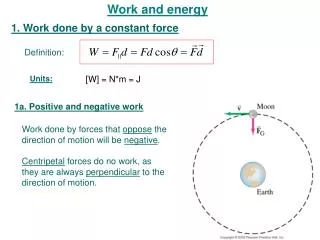
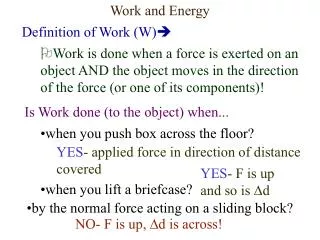
Work Physics definition of Work: Work : is the product of the magnitudes of the component of force along the direction of displacement and the displacement W = Fd F=ma W = m a d W = work F = force D = displacement
Work Work is done only when components of a force are parallel (same direction) to the displacement. NO WORK! displacement displacement force force WORK!
Is Work Happening? • A tug of war that is evenly matched • A student carries a bucket of water along a horizontal path while walking at a constant velocity. • A Crane lifting a car. • A person holding a heavy chair at arm’s length for several minutes. • A train engine pulling a loaded boxcar initially at rest.
Work Units Work = F x d Work = m x a x d Work = (newtons) (m) (Newton x m) = joules (J)
Work Problem 1 A tugboat pulls a ship with a constant horizontal net force of 5.00 x 10³ N. How much work is done if the ship is pulled a distance of 3.00 km? W = F x d = 5.00 x 10 3 N ( 3000 m) = 1.5 x 10⁷ Nm or J
Work Problem 2 If 2.0 J of work is done raising a 180 g apple, how far is it lifted? W =Fd F = mg = 0.18kg(9.8 m/s2) = 1.76 N W = Fd 2 J = (1.76N)d d = 1.1 m
Work Problem 3 A weight lifter lifts a set of weights a vertical distance of 2.00 m. If a constant net force of 350 N is exerted on the weights, what is the net work done on the weights? W = Fd W = 350 N x 2.00 m = 700 Nm or 700J
Sample Problem 4 What work is done by a forklift raising 583 kgs of frozen turkeys 1.2 m? W = Fd F = 583 kg (9.8 m/s2) = 5713.4 N W = 5713.4 N ( 1.2m) = 6856 Nm or 6856 J
Problems with Forces at Angles F θ X-direction Fx = Fcos θ Fy = Fsin θ Because the displacement of the box is only in the x direction only the x-component of the force does work on the box. W = Fdcosθ
Sample Problem A sailor pulls a boat a distance of 30.0 m along a dock using a rope that makes an angle of 25o with the horizontal. How much work is done if he exerts a force of 255 N on the rope? W = Fdcosθ = 255N(30m)cos25 = 6.93 x 10³J 255 N 250
Sliding up an Incline • What we calculated was... • For sliding an object up an incline.. W = Fd W = (mg sinθ) d
Sample Problem An airline passenger carries a 215 N suitcase up stairs, a displacement of 4.20 m vertically and 4.60 m horizontally. How much work does the passenger do? 4.2 m 4.6 m
Sample Problem 6.23 m First have to calculate hypotenuse and θ 4.2 m 42.40 4.6 m Tan θ = 4.2 m/ 4.6 m Θ = 42.40 Hypotenuse2 = A2 + B2 Hypotenuse2 = (4.2)2 + (4.6)2 Hypotenuse = 6.23 m
Sample Problem Suitcase weighs 215 N 6.23 m 4.2 m 42.40 4.6 m F║ = mg sinθ = 215 sin 42.4 = 145 N W = Fd = 145 N ( 6.23 m) = 903 J This should equal the force of the suitcase moving it vertically 4.2 m W = 215 N ( 4.2 m) = 903 J
Graphs of Force vs. Displacement Force Force Displacement Displacement Work = Fd Work can be found graphically by finding the area under the curve
Homework • Do Work/Energy/Power worksheet #1-4