The Impact of Collectivization in the Soviet Union: Lenin and Stalin's Policies
This chapter explores the major policies implemented during the Russian Revolution, focusing on the collectivization process initiated by Stalin as a continuation of Lenin's goals. It analyzes the increase in industrial output from the five-year plans and discusses the sociopolitical dynamics between Lenin's ideals and Stalin's authoritarian measures. The impact of collectivization on agriculture, including the destruction caused by peasant resistance, is examined alongside the government's response to the opposition. This chapter is essential for understanding the transformation of Soviet society under totalitarian rule.

The Impact of Collectivization in the Soviet Union: Lenin and Stalin's Policies
E N D
Presentation Transcript
Chapter 28:Russian Revolution K. Shaver and P. Gushue Week 22 1/26-1/29
Bell Ringer 1/26/2009 • Please hand in your bell ringers from last week, you should have 3! • Effects of the 5 year plans: • Look at the graph on page 710 of your text book. • The five-year plans increased Soviet industrial output. How much more steel was produced in 1938 than in 1928?
Now Hear This! • Test Chapter 28 Sections 1-3 • January 29, 2009! • Review sheet to follow…
Homework 1/26 • Read Primary Source Activity distributed in class. • Answer questions 1-4
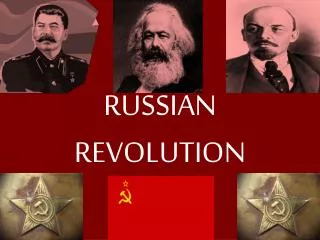
From Lenin to Stalin • Class Discussion: First Leaders of the USSR graphic. • In groups answer: • How did the main goal of Lenin differ from that of Stalin? • What did they have in common?
Collectivization • Collectives: state-run communal farms.
Collectivization: The Dream • Stalin forced peasants to live on these large farms owned and operated by peasants as a group. • All farm animals and implements were turned over to the collective. • The State set the prices • The grain from the collectives was to go to feed workers in the cities.
Collectives: The Reality • Peasants resisted • Killed farm animals, destroyed tools, burned crops. • The government responded with force. • Stalin wanted to destroy the kulaks (wealthy peasants) • He confiscated their land and forced them to work in labor camps. • Thousands were killed or died from over-work
Collectives: Evidence • Page 711: Synthesizing Information • Based on the evidence what were the social and economic impacts of collectivization? • What resulted from forcing people to relinquish private property? Why?
Make a list of the freedoms we enjoy in our society. Bell Ringer 1/27/2009
Homework 1/27/2009 • Read Chapter 28 Section 3 • Complete note-taking chart based on reading.
Life in a Totalitarian State • One Day in the Life of Ivan Denisovich
Bell Ringer 1/28/2009 • Lenin: “Of all the arts, for us the cinema is the most important.” • Why is film so important as a form of propaganda?
Reminder! • Test tomorrow Chapter 28 Sections 1-3!