Phylum Porifera
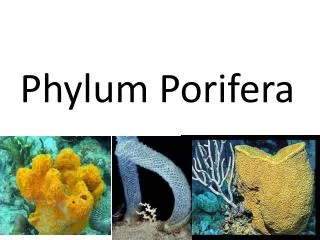
Phylum Porifera. Introduction. Sponges. Filter-feeding system many tiny pores and canals; adequate for their inactive life habit Sessile animals depend on water currents to bring them food and oxygen and carry away their body wastes No organs or true tissues
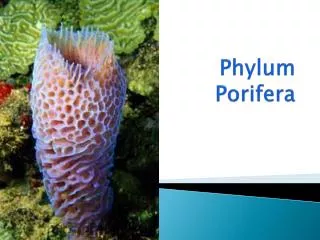

Phylum Porifera
E N D
Presentation Transcript
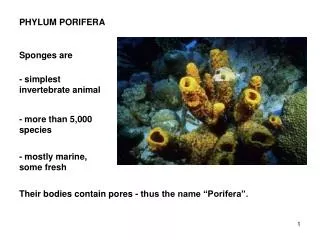
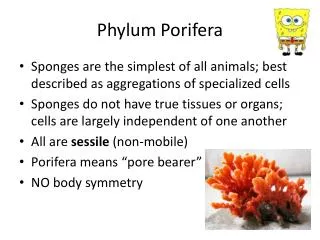
Sponges • Filter-feeding system • many tiny pores and canals; adequate for their inactive life habit • Sessile animals • depend on water currents to bring them food and oxygen and carry away their body wastes • No organs or true tissues • Bodies are little more than masses of cells embedded in a gelatinous matrix • stiffened by a skeleton of minute spicules • calcium carbonate or silica and collagen
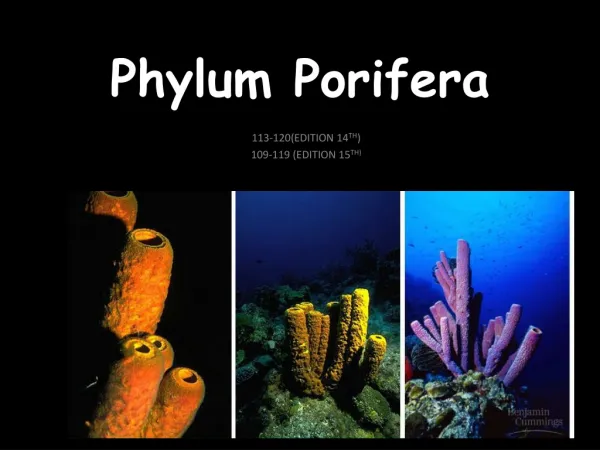
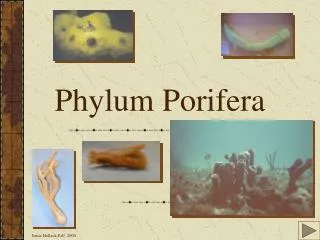
Sponges • Vary in size • few millimeters to more than 2 meters • Brightly colored • (red, yellow, orange, green, and purple) • Some are radially symmetrical, but many are quite irregular in shape • Some stand erect, some are branched or lobed, and others are low in form (encrusted)
Ecological Relationship • More than 5000 species of sponges are marine • 150 species live in fresh water • Found in all seas and at all depths • A few are found in brackish water • Embryos are free swimming • Adults attach to objects (rocks, corral, shells, etc.)
Ecological Relationship • The calmer the water, the taller and straighter the sponge grows • Larger sponges tend to harbor a large variety of invertebrates commensally • (one species benefits and the other is not harmed) • Elaborate skeletal framework and often noxious odor provide protection against predators
Form and Function • Ostia – many tiny pores for incoming water • (mouth) • Oscula – a few large pores for water outlet • (osculum – singular)
Form and Function • Choanocytes • Flagellated collar cells to maintain a current through the canals
Sponges Filtering Water • http://www.youtube.com/watch?v=T7E1rq7zHLc
Choanocytes also trap and phagocytize food particles that are carried in the water • Phagocytize – absorption through the cell wall creating food vacuoles
Sponge Physiology • Feed on particles suspended in water • Detritus particles, planktonic organisms, and bacteria • Digestion is entirely intracellular • Occurs within cells • Life activities depend on current of water • A large sponge can filter 1500 liters of water a day • Some sponges can crawl at speeds of up to 4 mm per day
Reproduction and Development • All sponges are capable of both sexual and asexual reproduction • In sexual reproduction, most sponges are monoecious • (have both male and female sex cells in one individual) • Sperm arise from transformation of choanocytes • Sperm is released into the water by one individual and taken into the canal system of another
Reproduction http://www.youtube.com/watch?v=SHJOu9PjKyU
Reproduction and Development • Parenchymula • solid-bodied; free-swimming larva of most sponge • Sponges reproduce asexually • fragmentation • forming external buds that detach or remain to form colonies
Taxonomy Kingdom Animalia (animals) • Phylum Porifera (sponges) • Class Calcarea • Class Hexactinellida • Class Demospongiae
Class Calcarea • Have spicules of calcium carbonate that often form a fringe around the osculum • Have spicules that are needle shaped or three- or four rayed • Have all three types of canal systems (asconoid, syconoid, leuconoid) • Are all marine
Class Hexactinellida • Have six-rayed, siliceous spicules extending at right angles from a central point • Spicules are often united to form network • Body often cylindrical or funnel shaped • Flagellated chambers in simple syconoid or leuconoid arrangement • Habitat mostly deep water; all marine
Class Demospongiae • Have skeleton of siliceous spicules that are six-rayed, or spongin, or both • Leuconoid-type canal systems • One family found in fresh water; all others marine
Form and Function – Types of Skeleton • Major structural protein in the animal kingdom is collagen • Fibrils of collagen are found throughout the intercellular matrix of all sponges • Demospongiae secrete a form of collagen known as spongin • They also secrete siliceous spicules
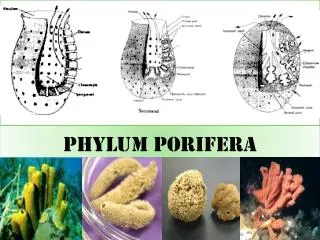
Form and Function • Collapse of the canals is prevented by the skeleton of spicules, spongin fibers, or both • Most sponges have one of three types of canal systems – asconoid, syconoid, leuconiod
Form and Function – Types of Canal Systems Asconoids – Flagellated Spongocoels • Have the simplest organization – small and tube shaped • Water enters through microscopic dermal pores (ostia) into a large cavity called a spongocoel • Spongocoel is lined with choanocytes which pull water through the pores and expel it through a single large osculum
Leucosolenia – slender, tubular individuals grow in groups attached by a common stolon (stem) attached to objects in shallow seawater.
Clathrinacanariensis – bright yellow with intertwined tubes common on Caribbean reefs in caves and under ledges
Form and Function – Types of Canal Systems Syconoids – Flagellated Canals • Look like larger editions of asconiod, from which they are derived • Have tubular body and a single osculum which is folded back and forth to make canals • Choanocytes line certain folds called radial canals
Form and Function – Types of Canal Systems • Water enters the ostia into the incurrent canals • Then it moves into radial canals via small lateral openings called prosopyles • Filtered water then moves through apopyles into the spongocoel, finally exiting by the osculum • Spongocoel is lined with epithelial-type cells
Form and Function – Types of Canal Systems Leuconoids – Flagellated Chambers • Most complex of the sponge, which permits for increased size • Most have numerous oscula • Clusters of flagellated chambers are filled from incurrent canals and discharge water into excurrent canals that eventually lead to the osculum
Form and Function – Types of Canal Systems continued….. • This increases the proportion of flagellated surfaces compared to volume, providing more collar cells to meet food demands • Most sponges are leuconoids