
SlideServe
Menu
Préférences
© SlideServe · v2026

Phylum Porifera

shamara avatar
14 diapositives · 1.8K Views · Jun 24, 2012

Phylum Porifera. Table of Contents. General description Sponge canal system Unique characteristics Systems (integument, skeletal, muscle, digestive) Systems (respiratory, circulatory, nervous) Systems (endocrine and reproductive) Taxonomy Calcispongiae Hyalospongiae Demospongiae.
Phylum Porifera - slide 1
01 / 14Phylum Porifera
1 / 17

Télécharger la présentation

Phylum Porifera
Une image / un lien ci-dessous est fourni (tel quel) pour télécharger la présentation

Politique de téléchargement : le contenu du site vous est fourni TEL QUEL pour votre information et votre usage personnel ; il ne peut être vendu, concédé sous licence ni partagé sur d’autres sites sans l’accord de son auteur.Le contenu vous est fourni TEL QUEL, pour votre information et votre usage personnel uniquement. Téléchargez la présentation en cliquant sur ce lien. Lors du téléchargement, si vous ne parvenez pas à télécharger une présentation, l’éditeur a peut-être supprimé le fichier de son serveur.Pendant le téléchargement, si vous ne parvenez pas à obtenir une présentation, le fichier a peut-être été supprimé par l’éditeur.

F I N

Plus de contenu associé

Transcription de la présentation
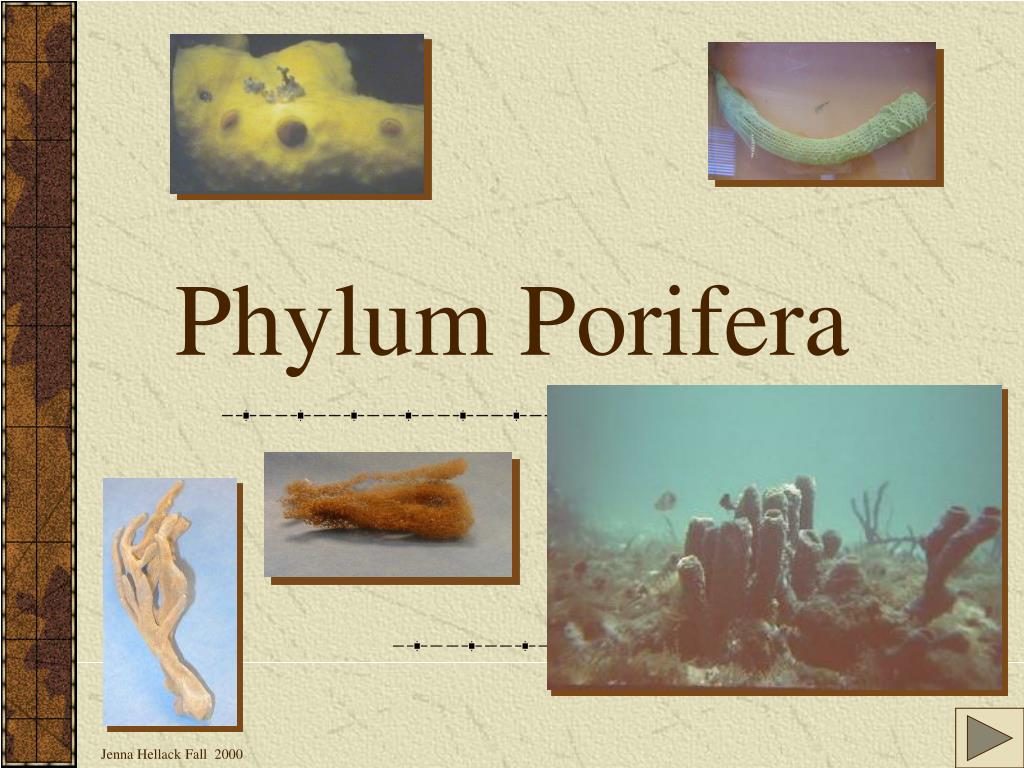
  1. Phylum Porifera

  2. Table of Contents • General description • Sponge canal system • Unique characteristics • Systems (integument, skeletal, muscle, digestive) • Systems (respiratory, circulatory, nervous) • Systems (endocrine and reproductive) • Taxonomy • Calcispongiae • Hyalospongiae • Demospongiae

  3. Phylum Porifera (por-if-er-a) • Grouped as Parazoans - multicellular animals with no well-defined tissue. • They are sessile, and asymmetrical (sometimes with radial symmetry). Body organized around a system of water canals and chambers

  4. Sponge Canal Systems • The body plans or structures are based on complexity of water-canal and skeletal system • Asconoid • Choanocytes line the spongocoel • Syconoid • Choanocytes are in radial canals off spongocoel • Leuconoid • Choanocytes are in chambers off of the radial canals.

  5. Some unique characteristics • Spicules • Choanocytes (collar cells) • No true tissue • Pores • Body plans (asconoid, syconoid, leuconoid)

  6. Porifera Systems • Integumentary • Pinacocytes - thin flat layer of T-shaped cells • Skeletal • Spicules and spongin(forms of collagen) • Muscle • Movement cellular by flagella and pseudopodia • Digestive • Intracellular; use choanocytes to trap food.

  7. Porifera Systems • Excretory • Marine are isotonic, freshwater forms use contractile vacuoles. • Respiratory • diffusion by individual cells • Circulatory • Choanocytes create current, ameboid cells transport food • Nervous • Cell irritability shown by individual cells

  8. Porifera Systems • Endocrine • endocrine like chemical present within individual cells • Reproductive • External fertilization, or sperm brought in choanocytes and fertilization occurs in chambers. • Asexual: regenerate whole sponge from a few spicules, choanocytes and amoeboid cells. • Gemmulesin freshwater sponge (a few marine ones)

  9. Spongin Gemmule Arrow pointing to spicule Spicules

  10. Porifera Taxonomy • Class: Calcispongiae (cal-si-spon-ge-a) • Scypha (Grantia or Sycon) • Leucosolenia • Class: Hyalospongiae(hi-a-lo-spon-ge-a) • Euplectella • Class: Demospongiae(dem-o-spon-ge-a) • Euspongia (Spongia) • Spongilla • Class: Sclerospongiae (skler-o--spon-ge-a) • No specimens

  11. Taxonomy Leucosolenia (stained) Grantia (Scypha) Spicules Class Calcispongiae • Spicules of calcium carbonate (all three canal systems present in class)

  12. Class Hyalospongiae • Six-rayed silicon spicules Euplectella (Venus’ flower basket)

  13. Class Demospongiae • Presence of spongin, or silicon spicules (that are not six-rayed) or both. Euspongia (Spongia) Spongilla

  14. End of Phylum Porifera