Download
1 / 6
60 likes | 185 Vues
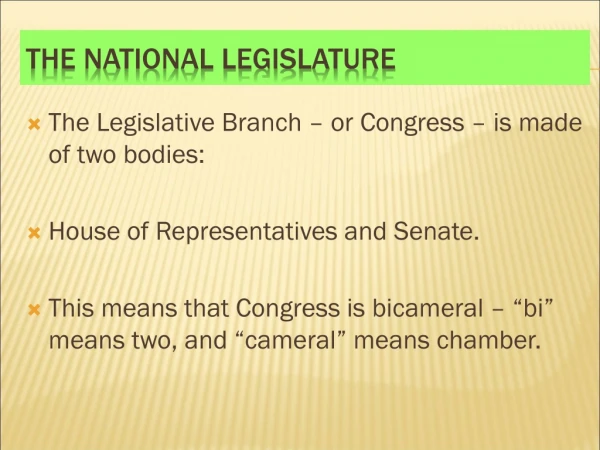
This overview of the U.S. legislative system highlights the dual nature of Congress, consisting of the Senate and the House of Representatives. It explains the concept of representative democracy, the historical basis of the bicameral structure, and how it serves to balance power. The document details the terms and sessions of Congress, including the duration of terms, the scheduling of sessions, and the role of the President in calling special sessions. This information is crucial for understanding how government operates on a daily basis.

E N D
National Legislature Unit 3 Notes
SENATE HOUSE OF REP. • We live in a REPRESENTATIVE DEMOCRACY • SENATE • HOUSE OF REP. • representatives of the people are responsible for the day-to-day work of the gov’t • Ex: Congress
Bicameral Congress • Made up of 2 houses- Senate/ House of Rep. • Historical Basis • based on British parliament (1300s) • Practical • settled conflict btwn. VA & NJ Plans • Theoretical • one house acts a check on the other • Bicameral Congress splits the power of Congress so it does not overwhelm the other 2 branches
Terms of Congress • Term of Congress= 2 years • Each term numbered consecutively • Start of new term= “noon of the 3 day of January”, every odd numbered year • Ex: term of 109th Congress began on Jan.3, 2005 and ended Jan.7, 2007
Sessions of Congress • Period of time each year, Congress assembles and conducts business • 2 sessions → each term • 1 session → each year • Congress adjourns (suspends until next session, each time it sees fit) • President has the power to PROROGUE • end, discontinue a session but only when the 2 houses cannot aggreeon a date for adjournment
Special Sessions of Congress • President calls Congress, usually a meeting to deal w/ some emergency situation • Congress meets nearly year round so usually there are never special sessions