

SlideServe
Menu
Préférences
© SlideServe · v2026

Neutron Stars

dionne avatar
17 diapositives · 565 Views · Feb 23, 2013

0. Neutron Stars . 0. Gradual compression of a stellar iron core. Radial Structure of a Neutron Star. - Heavy Nuclei ( 56 Fe). - Heavy Nuclei ( 118 Kr); free neutrons; relativistic, degenerate e -. - Superfluid neutrons. 0. Properties of Neutron Stars. Typical size: R ~ 10 km.
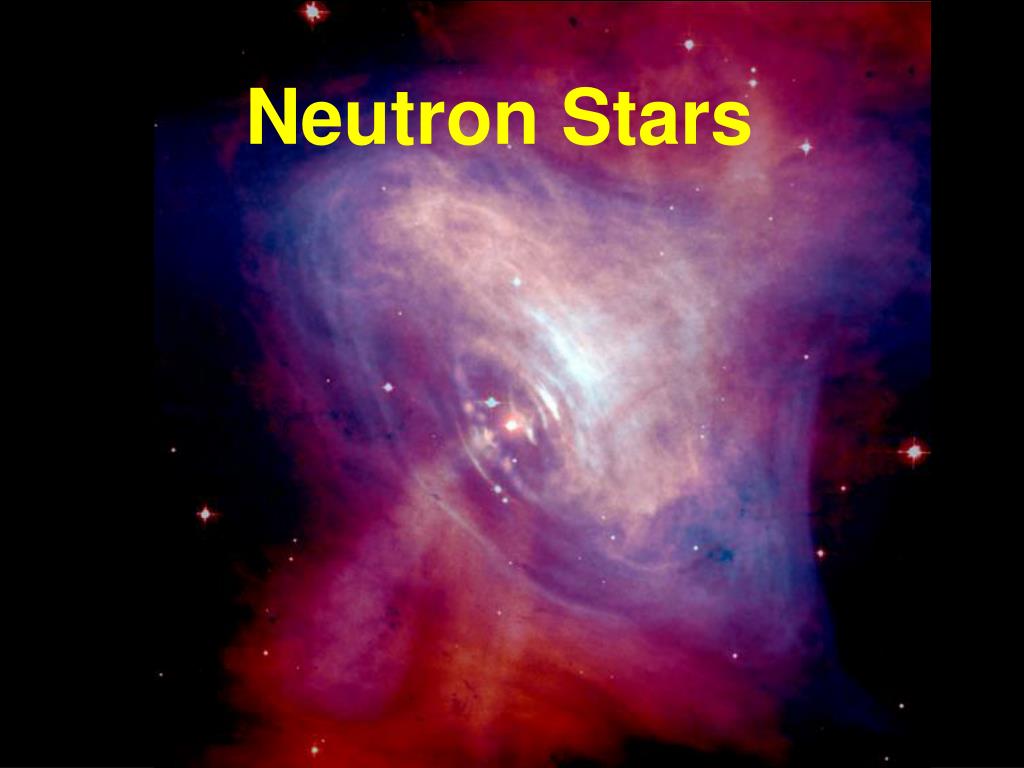
Neutron Stars - slide 1
01 / 17Neutron Stars
1 / 17

Télécharger la présentation

Neutron Stars
Une image / un lien ci-dessous est fourni (tel quel) pour télécharger la présentation

Politique de téléchargement : le contenu du site vous est fourni TEL QUEL pour votre information et votre usage personnel ; il ne peut être vendu, concédé sous licence ni partagé sur d’autres sites sans l’accord de son auteur.Le contenu vous est fourni TEL QUEL, pour votre information et votre usage personnel uniquement. Téléchargez la présentation en cliquant sur ce lien. Lors du téléchargement, si vous ne parvenez pas à télécharger une présentation, l’éditeur a peut-être supprimé le fichier de son serveur.Pendant le téléchargement, si vous ne parvenez pas à obtenir une présentation, le fichier a peut-être été supprimé par l’éditeur.

F I N

Plus de contenu associé

Transcription de la présentation
  1. 0 Neutron Stars

  2. 0 Gradual compression of a stellar iron core

  3. Radial Structure of a Neutron Star - Heavy Nuclei (56Fe) - Heavy Nuclei (118Kr); free neutrons; relativistic, degenerate e- - Superfluid neutrons

  4. 0 Properties of Neutron Stars Typical size: R ~ 10 km Mass: M ~ 1.4 – 3 Msun Density: r ~ 4x10¹⁴ g/cm3 → 1 teaspoon full of NS matterhas a mass of ~ 2 billion tons!!! Rotation periods: ~ a few ms – a few s Magnetic fields: B ~ 108 – 1015 G (Atoll sources; ms pulsars) (magnetars)

  5. 0 Neutron Star Cooling Tc ~ 1011 K n → p + e- + ne p + e- → n + ne (non-degenerate n, p) ~ 1 d URCA process: Tc ~ 109 K ~ 1,000 yr neutrino cooling Tc ~ 108 K Lph ~ 7x1032 erg/s lmax ~ 30 Å (soft X-rays) Tc ~ 108 K; Teff ~ 106 K for ~ 10,000 yr

  6. 0 The Lighthouse Model of Pulsars A Pulsar’s magnetic field has a dipole structure, just like Earth. Radiation is emitted mostly along the magnetic poles. Rapid rotation along axis not aligned with magnetic field axis → Light house model of pulsars Pulses are not perfectly regular → gradual build-up of average pulse profiles

  7. 0 Pulsar Emission Models:Polar Cap model Particle acceleration along magnetic field lines Synchrotron emission Curvature radiation Pair production Electromagnetic cascades

  8. Pulsar Emission Models:Outer Gap model W Electrons are bound to magnetic fields co-rotating with the pulsar At a radial distance r = c/W co-rotation at the speed of light → “light cylinder” → Particles ripped off magnetic fields Synchrotron emission Curvature radiation Light Cylinder

  9. 0 Pulsar periods and derivatives Associated with supernova remnants Mostly in binary systems

  10. 0 Pulsar periods Over time, pulsars lose energy and angular momentum => Pulsar rotation is gradually slowing down. dP/dt ~ 10-15 Pulsar Glitches: DP/P ~ 10-7 – 10-8

  11. 0 Energy Loss of Pulsars From the gradual spin-down of pulsars: d dE/dt = (½ I w2) = I w w = - (1/6) m┴2w4 r4 c-3 dt m┴ ~ B0 r sin a One can estimate the magnetic field of a pulsar as B0 ≈ 3 x 10¹⁹√PP G

  12. 0

  13. 0

  14. 0 Images of Pulsars and other Neutron Stars The vela Pulsar moving through interstellar space The Crab nebula and pulsar

  15. 0 The Crab Pulsar Pulsar wind + jets Remnant of a supernova observed in A.D. 1054

  16. 0 The Crab Pulsar Visual image X-ray image

  17. 0 Dispersion of Pulsar Signals dt = (4pe2/mecw13) dw DM d DM = ∫ ne(s) ds 0 DM = Dispersion Measure