
190 likes | 328 Vues
After WWII, Korea was divided at the 38th parallel, leading to the Korean War in June 1950 when North Korean troops invaded the South. The United States rallied UN forces to protect South Korea, resulting in a stalemate by July 1951. The Cold War escalated with an arms race post-Stalin's death in 1953, as nuclear capabilities expanded globally. Events like the Cuban Missile Crisis exemplified the intense geopolitical tensions between the US and Soviet Union, impacting newly independent nations and shaping international relations.
E N D
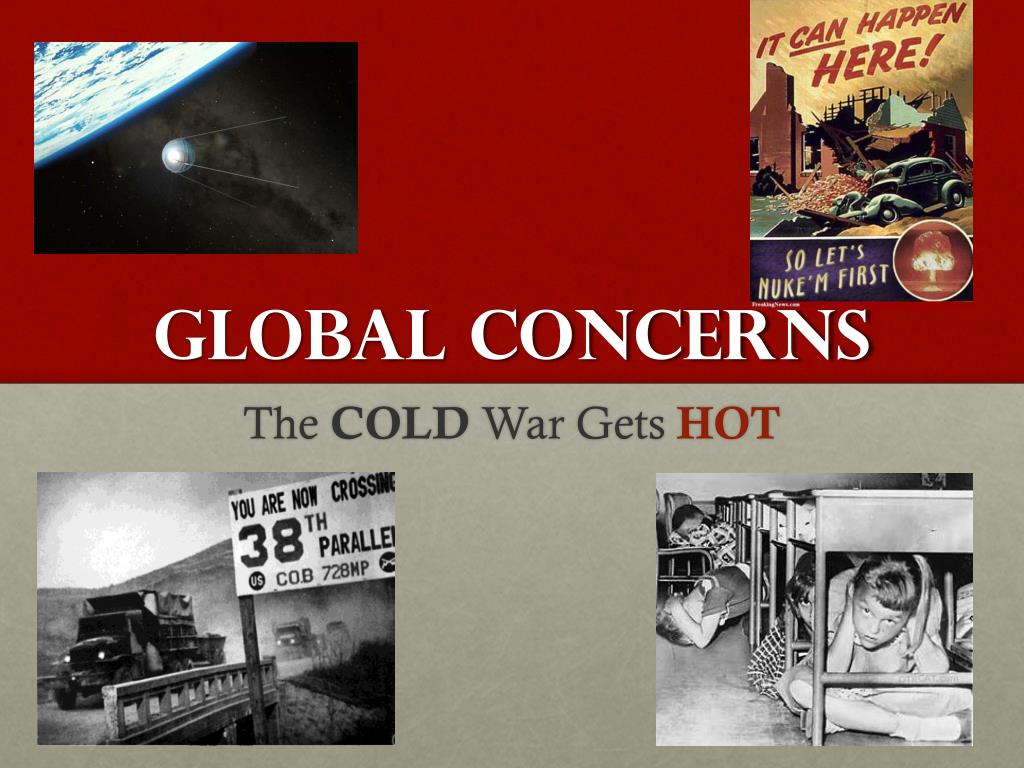
Global concerns The COLD War Gets HOT
Conflict in Korea • After WWII, Korea was divided at the 38th parallel of latitude • The Soviets backed a communist government in the NORTH while the United States set up a non-communist government in the SOUTH
The forgotten war • June 1950: North Korean troops invade South Korea (aided by Soviet tanks and artillery) – NK troops get all the way to South Korean capital of Seoul • President Truman urges the UN to send military force to protect South Korea (90% were American troops) • The UN forces push the North Korean military back nearly to China GOING SOUTH BACK NORTH Charlie Johnson
CONFLICT IN KOREA • Chinese troops join with the North Koreans and push south • There, the war settles into a STALEMATE– a situation in which neither side wins • July 1951: Peace talks begin (fighting continues) • July 1953: A CEASE-FIREends the fighting and a demilitarized zone is established, dividing the two counties SOUTH AGAIN
THE ARMS RACE • 1953: Josef Stalin dies in – Nikita Khrushchev replaces him as ruler of the Soviet Union • Khrushchev wanted communism to DESTROY western democracy
THE arms race • During this time, the Soviets and the Americans began competing in an arms race • China, Britain, and France join in developing their own nuclear weapons • Not wanting to risk deadly attacks, all countries started stockpiling their weapons
H- BOMB • 1952: The Americans exploded the first hydrogen bomb • Soon afterward, the Soviets explode their own H-bomb
sputnik • World’s first man-made satellite, launched by the Soviet Union • Led to the U.S./Soviet Union SPACE RACE competition • U.S. creates NASA (National Aeronautics and Space Administration) If the Soviets could send satellites into space WHAT ELSE WERE THEY CAPABLE OF?
New nations gain independence • DEVELOPMENTS IN AFRICA • Soviet Union and the United States competed for influence in newly formed countries like Ghana, Guinea, and the Congo • THE PHILLIPINES • Filipinos fought their new government for land reforms (some of these rebels were communists) • INDOCHINA • Vietnam struggled for independence led to the Vietnam War
PEACE CORPS • President John F. Kennedy proposed the creation of the PEACE CORPS to win support in these newly created nations • The Soviet Union was also trying to build friendships • Americans volunteered in third-world countries around the world as teachers, doctors, nurses, carpenters, and farmers
AY Dios MiosCastro • 1959: Fidel Castro and his communist party led a successful revolution in Cuba • He (and his comrade Che Guevara) encouraged other Latin American countries to follow suit • Many Cubans fled to the United States • Bay of Pigs Invasion: The U.S. secretly trained some of these exiles and attempted to invade Cuba and overthrow Castro……it failed.
Cuban Missile crisis • The closest the United States and the Soviet Union came to an all out nuclear war • American planes took pictures of Soviet nuclear missile cases in Cuba • Kennedy blockaded Cuba – stopping any Soviet ship from bringing missiles to Cuba • For 13 days, heated talks between Kennedy and Khrushchev attempted to solve the crisis • In the end, Khrushchev agreed to remove the missiles and Kennedy agreed not invade Cuba