Division
This article delves into the complexities of division algorithms, highlighting the challenges such as overflow conditions when dividing by small numbers or zero. It explores various methods, including shift-and-subtract and array-based algorithms, along with sequential division approaches like signed and unsigned divisions. Focus is placed on selecting quotient digits in fractional and integer divisions, and how to manage overflow through effective checks. Additionally, high-radix division techniques such as Radix-2 and Radix-4 are covered to showcase advanced computational strategies.

Division
E N D
Presentation Transcript
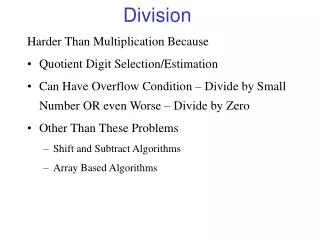
Division Harder Than Multiplication Because • Quotient Digit Selection/Estimation • Can Have Overflow Condition – Divide by Small Number OR even Worse – Divide by Zero • Other Than These Problems • Shift and Subtract Algorithms • Array Based Algorithms
Division Notation 2k by k Bit Division – Dot Diagram
Sequential Division • Repeated Subtractions vs. Repeated Additions • Partial Remainder Initialized to z, s(0)=z • Step j, Select Next Quotient Digit qk-j • Product qk-jd (equals either 0 or d) is Shifted • Result Subtracted From Partial Remainder • Thus, as Complex as Multiplication with ADDITIONAL Constraint that Quotient Digit Selection is Required
Overflow • Quotient of 2k-bit Value Divided by k-bit Number can Result in Width Greater than k • Overflow Check Needed Before Division is Attempted • For Unsigned Division: • High-order k Bits of z Must be Strictly Less Than d • This Check Also Detects the Divide-by-zero Condition
Fractional Division • Integer Division Characterized by: • Multiplying Both Sides by 2-2k: • Letting 2k and k Bit Inputs be Fractions: • Thus, Can Divide Fractions Just Like Integers Except: • Must Shift Final Remainder to Right by k Digits • Condition for No Overflow zfrac < dfrac
SRT Algorithm • Divisor normalized to d ½ • Restrict partial remainder to [ -½, ½) instead of [-d,d) • Initially may need to shift z to right, then double q and s at end • All subsequent partial remainders in range [ -½, ½) using quotient digit selection rule: If 2s(j-1) < - ½ Then q–j = -1 Else if 2s(j-1) - ½ then q–j = 1 else q–j = 0 endif endif • Just two comparisons needed with constants – ½ and + ½
SRT Example-Unsigned Radix-2 Comparison on No, In [-½, ½), so q-3 = 0. Also, q-4 = -1