Download
1 / 5
90 likes | 329 Vues
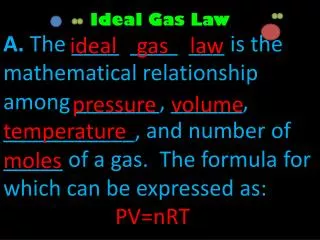
The Ideal Gas Law (PV=nRT) describes the behavior of ideal gases, which perfectly follow kinetic molecular theory assumptions. It highlights how pressure (P in atm), volume (V in liters), moles (n), and temperature (T in Kelvins) relate under low-pressure conditions (P < 1 atm). Ideal gases consist of particles in constant motion that are far apart and engage in elastic collisions. In contrast, real gases exhibit intermolecular attractions, have volume, and do not behave ideally, leading to deviations from theoretical predictions.

E N D
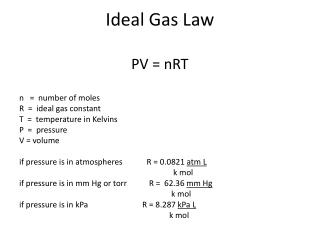
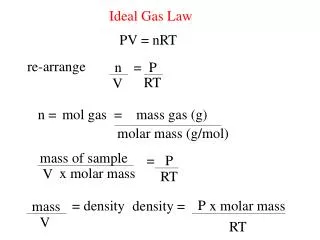
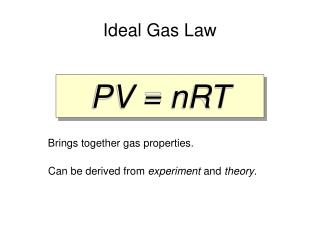
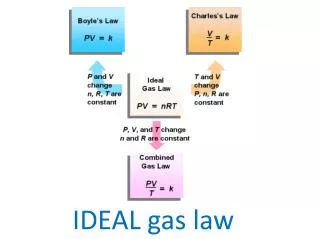
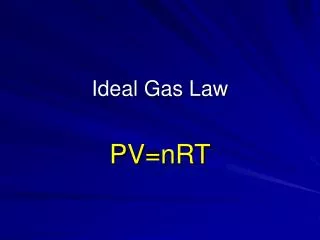
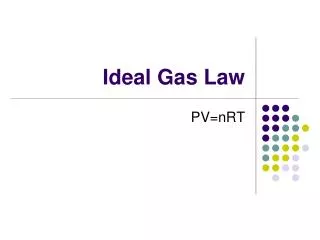
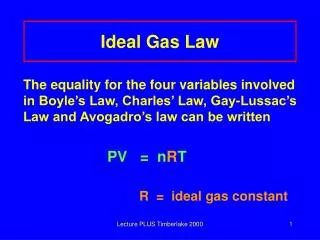
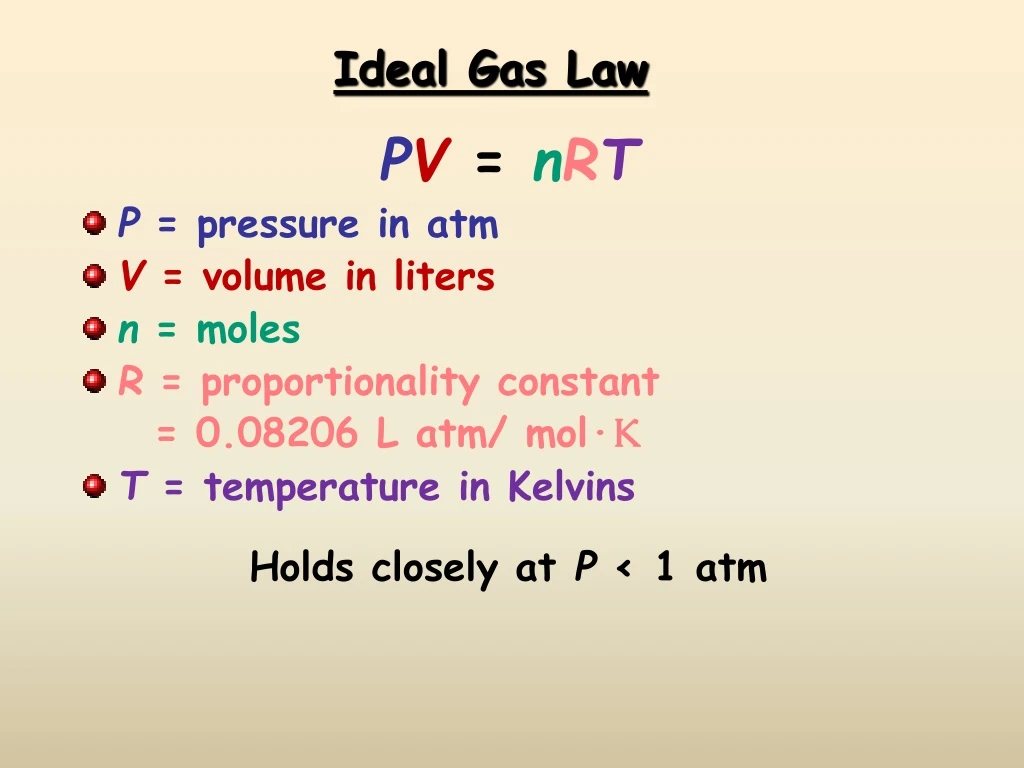
PV=nRT P= pressure in atm V = volume in liters n = moles R = proportionality constant = 0.08206 L atm/ mol·K T = temperature in Kelvins Ideal Gas Law Holds closely at P < 1 atm
Ideal Gases Ideal gases are imaginary gases that perfectly fit all of the assumptions of the kinetic molecular theory. • Gases consist of tiny particles that are far apart • relative to their size. • Collisions between gas particles and between • particles and the walls of the container are • elastic collisions • No kinetic energy is lost in elastic • collisions
Ideal Gases (continued) • Gas particles are in constant, rapid motion. They • therefore possess kinetic energy, the energy of • motion • There are no forces of attraction between gas • particles • The average kinetic energy of gas particles • depends on temperature, not on the identity • of the particle.
Real Gases Do Not Behave Ideally Real gases DO experience inter-molecular attractions Real gases DO have volume Real gases DO NOT have elastic collisions