Download
1 / 3
30 likes | 135 Vues
Delve into the debate between fate and free will with insights from Aristotle, Augustine, d’Holbach, Laplace, Freud, and Skinner. Contemplate whether our behavior is predetermined by forces beyond our control or shaped by conscious decisions.

E N D
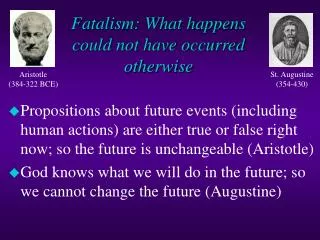
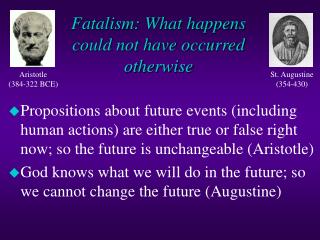
Fatalism: What happens could not have occurred otherwise Aristotle (384-322 BCE) • Propositions about future events (including human actions) are either true or false right now; so the future is unchangeable (Aristotle) • God knows what we will do in the future; so we cannot change the future (Augustine) St. Augustine (354-430)
Determinism: All events (including human actions) have specific causes • Baron d’Holbach: the brain is material; so its actions (e.g., thought, will) are controlled by physical laws, heredity, and environment (1723-89) • Pierre-Simon Laplace: with a complete knowledge now of every particle in the universe, we could predict all future events (1749-1827)
Contemporary Explanations of Behavior S. Freud (1856-1939) B.F. Skinner (1904-90) Our behavior is caused by: • unconscious desires or fears and repressed memories (Freud) • environment, social conditioning (Skinner) • heredity, genes Objections: these accounts seem to make freedom an illusion. But (1) how are we able to change? And (2) why not explain behavior with reasons, not causes?