Exploring Different Points of View in Storytelling
40 likes | 165 Vues
This article delves into the various points of view (POV) used in literature, focusing on first-person, second-person, and third-person perspectives. The first-person POV allows readers to experience the narrator's thoughts and emotions but limits knowledge to that character's understanding. The rare second-person POV engages readers directly, creating an intimate experience. The third-person POV can be omniscient, revealing multiple characters' thoughts, or limited, focusing on just one character's perspective. Examples from well-known works illustrate each approach, emphasizing the unique insights they offer.


Exploring Different Points of View in Storytelling
E N D
Presentation Transcript
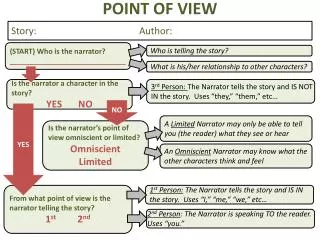
First-Person POV • First-person point of view is in use when a character narrates the story with I-me-my-mine in his or her speech. • Advantage of this point of view: you get to hear the thoughts of the narrator and see the world depicted in the story through his or her eyes. • Disadvantage: no narrator, like no human being, has complete self-knowledge or, for that matter, complete knowledge of anything. Therefore, the reader's role is to go beyond what the narrator says. • Example: Harper Lee's To Kill a Mockingbird is told from the point of view of Scout, a young child. She doesn't grasp the complex racial and socioeconomic relations of her town — but the reader does, because Scout gives information that the reader can interpret.
Second-Person POV • Second-person point of view, in which the author uses you and your, is rare; authors seldom speak directly to the reader. • When you encounter this point of view, pay attention. Why? The author has made a daring choice, probably with a specific purpose in mind. • Example: Jay McInerney's best-selling Bright Lights, Big City was written in second person to make the experiences and tribulations of the unnamed main character more personal and intimate for the reader. • You are not the kind of guy who would be at a place like this at this time of the morning. But here you are, and you cannot say that the terrain is entirely unfamiliar, although the details are fuzzy. —Opening lines of Jay McInerney'sBright Lights, Big City (1984)
Third-Person POV • Third-person point of view is that of an outsider looking at the action. • Third-person omniscient: in which the thoughts of every character are open to the reader • Example: In the Game of Thrones series, each chapter is told through a different character’s point of view, so you get to see all the different sides to the story. Fascinating! • third-person limited: in which the reader enters only one character's mind, either throughout the entire work or in a specific section. Third-person limited differs from first-person because the author's voice, not the character's voice, is what you hear in the descriptive passages. • Most writers choose this point of view. Examples: The Hobbit, Harry Potter series, etc.