Download
1 / 21
210 likes | 323 Vues
This educational resource explores the vital role of chloroplasts in photosynthesis, highlighting how autotrophs like green plants produce their own food using sunlight. It contrasts them with heterotrophs, such as animals and fungi, that obtain energy by consuming other organisms. The text also discusses how cells use ATP as an energy currency, storing and releasing energy for various cellular functions, including active transport, movement, and synthesis. This comprehensive overview emphasizes the importance of carbohydrates in providing energy for living organisms.

E N D
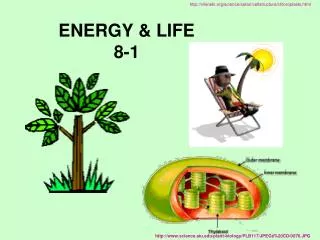
http://vilenski.org/science/safari/cellstructure/chloroplasts.htmlhttp://vilenski.org/science/safari/cellstructure/chloroplasts.html ENERGY & LIFE8-1 http://www.science.siu.edu/plant-biology/PLB117/JPEGs%20CD/0076.JPG
http://www.newtonswindow.com/problem-solving.htm Remember from BIO 1 _____________ can make their own food usingenergy from sunlight. AUTOTROPHS Ex: Green plants, a few bacteria http://www.seorf.ohiou.edu/~tstork/compass.rose/photosynthesis/chloro_sun_bathing.gif
http://www.newtonswindow.com/problem-solving.htm Remember from BIO 1 HETEROTROPHS __________________ get energy by consumingother organisms Ex: Animals, fungi, most bacteria http://www.epa.gov/region5/superfund/ecology/images/fishcartoon.gif
Remember from BIO 1 WHAT DO CELLS USE ENERGY FOR ? ACTIVE TRANSPORT Na+ - K + PUMPEndocytosis Exocytosis Images: http://www.newtonswindow.com/problem-solving.htm http://www.lionden.com/cell_animations.htm http://academic.brooklyn.cuny.edu/biology/bio4fv/page/cell-movement.html Animation from:
WHAT DO CELLS USE ENERGY FOR ? Movement Synthesis of biomolecules Reproduction Meiosis: http://www.tokyo-med.ac.jp/genet/anm/ Cilia: http://www.sk.lung.ca/content.cfm?edit_realword=hwbreathe Replication: http://www.beyondbooks.com/lif71/4c.asp Transcription:http://www.wappingersschools.org/RCK/staff/teacherhp/johnson/visualvocab/mRNA.gif Translation:
http://www.newtonswindow.com/problem-solving.htm Remember from BIO 1 ONE SPECIAL KIND of NUCLEOTIDE is used by cells to store and transport ENERGY ATP Image by: Riedell
CELLS USE ATP TO STORE and RELEASE ENERGY 3 ____ PHOSPHATE GROUPS ATP = __________________________ Adenosine triphosphate
ATP can change into ADP 2 ____ PHOSPHATE GROUPS ADP = __________________________ Adenosine diphosphate
http://www.cat.cc.md.us/~gkaiser/biotutorials/energy/adpan.htmlhttp://www.cat.cc.md.us/~gkaiser/biotutorials/energy/adpan.html ATP releases energy stored in a high energy chemical bond by removing the phosphate and becoming ADP ATP→ ____ + ____ + ADP
Cells ________ energy by adding the phosphate back on to ADP to make ATP. STORE The energy to do this comes from ____________ like _____________ FOODS GLUCOSE It’s like recharging the battery ! ADP+ ___ + ________ → ___ ATP
ATP is useful BUT . . . NOT LARGE ATP is great for TRANSFERRING ENERGY, but _____ good for storing ________ amounts of energy for the ______________. A single molecule of GLUCOSE stores more than _________the chemical energy. Cells only keep enough ATP around to last a few seconds and recharge it by burning___________. LONG TERM 90 times glucose http://www.estrellamountain.edu/faculty/farabee/biobk/BioBookCHEM2.html
http://www.newtonswindow.com/problem-solving.htm Remember from BIO 1 Example: GLUCOSE C6H12O6 CARBOHYDRATES containCarbon, Hydrogen, & Oxygen (with a ratio of 1 C: 2 H: 1 O) Image from: http://www.estrellamountain.edu/faculty/farabee/biobk/BioBookCHEM2.html
MONOSACCHARIDESSingle sugar molecules C6H12O6 C6H12O6 C6H12O6 http://www.estrellamountain.edu/faculty/farabee/biobk/BioBookCHEM2.html http://217.60.75.10/llt/biokemi/images/galactose.jpg http://217.60.75.10/llt/biokemi/images/galactose.jpg http://www.estrellamountain.edu/faculty/farabee/biobk/BioBookCHEM2.html C5H10O5
Remember from BIO 1 CARBOHYDRATES SUPPLY ENERGY Cells burn GLUCOSE for their energy needs Images from: http://www.miranda.com/library.en/Images/Pictures/girls-runners.jpg http://www.estrellamountain.edu/faculty/farabee/biobk/BioBookCHEM2.html
CARBOHYDRATES are building blocks for other molecules ATP DNA & RNA POLYSACCHARIDES http://www.estrellamountain.edu/faculty/farabee/biobk/BioBookCHEM2.html ATP by Riedell http://evolution.berkeley.edu/evosite/evo101/images/dna_bases.gif http://sps.k12.ar.us/massengale/biochemistry_notes_bi_ch3.htm
Remember from BIO 1 Section 2-3 Starch Glucose
Molecules made by joining MANY sugar molecules together are called ___________________ POLYSACCHARIDES EXAMPLES: Image from: http://bioweb.wku.edu/courses/BIOL115/Wyatt/Biochem/Carbos/Carb_poly.gif
CARBOHYDRATES SUPPLY ENERGY GLYCOGEN is the way _________ cells store GLUCOSE to use later. ANIMAL Image from: http://www.msu.edu/course/lbs/145/smith/s02/graphics/campbell_5.6.gif
CARBOHYDRATES SUPPLY ENERGY STARCH is the way _______ cells store GLUCOSE for later. PLANT Images from: http://bioweb.wku.edu/courses/BIOL115/Wyatt/Biochem/Carbos/Carb_poly.gif http://oregonstate.edu/instruction/bb450/stryer/ch21/Slide24.jpg