Wars and Foreign Entanglements
340 likes | 451 Vues
Explore key wars such as French and Indian, American Revolution, Civil War, both World Wars, Korean War, and the Cold War, with detailed historical overviews and impacts on global politics.


Wars and Foreign Entanglements
E N D
Presentation Transcript
Wars and Foreign Entanglements By: Cory Bennett, Dylan Johnson, and Ty Woolf
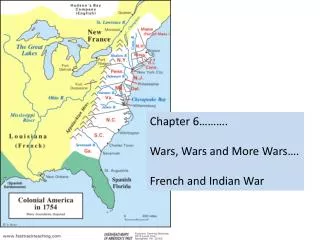
French and Indian War • 1754-1763 • Between Great Britain and France • Both sides utilized Native Americans for their sides. • Fought in North America • Part of the Seven Years War between Britain and France
French and Indian War • Fought over Colony possession between France and Britain as well as territorial conquest of the Americas. • Started due to increasing population and need for larger markets and territory between France and Britain • British Victory
American Revolution • 1775-1783 • War over American Independence from Britain • United States vs. Great Britain • Fought in North America • The 13 colonies resented British colonial rule without representation from the colonies
American Revolution • America fought with conventional as well as guerilla forces against the British, resulting in American independence • American forces won, creating the United States of America • At conclusion of the war, the U.S. created a weak central government – The Articles of Confederation • States were governed by their own state governments and policies.
War of 1812 • 1812-1815 • Fought between America and Great Britain • Fought in the United States • War was declared by the United States on Britain for a number of reasons. • America was victorious over Britain…AGAIN!
Mexican-American War • 1846-1848 • United States vs. Mexico • America annexed Texas in 1845 • Mexico still saw Texas as Mexican territory even after the Revolution in 1836 • Mexico threatened America with war if U.S. annexed Texas
Mexican-American War • American military conquered Mexican territory of now Nevada, Arizona, California • United States Army captured Mexico City, causing Mexico to relinquish control of its conquered territories • Border between Mexico and U.S. is the Rio Grande River.
Civil War • 1860-1865 • Fought in the United States • Northern “Free” States vs. Southern “Slave” States • Southern States seceded from the Union to form the Confederacy • War was fought over primarily the abolishment of Slavery in new territories
Spanish-American War • April 25, 1898-August 12, 1898 • Fought in Cuba • Started after political pressure on the U.S. Government by the public after the sinking of the U.S.S. Maine in Havana Harbor • Cubans showed much resistance toward their Spanish rulers
Spanish-American War • American public was angered by Spanish atrocities toward the Cuban resistance and civilians • American Naval forces won numerous battles in the Caribbean as well as the Pacific
World War I • 1914-1918 • American Intervention: 1917-1918 • Central Powers: Germany, Austria-Hungary, Turkey, Bulgaria (later joined) • Allied Powers: U.S.A., Great Britain, France, Russia (early withdrawal), Italy, Japan (later joined)
World War I • Fought in Central Europe and the Atlantic Ocean • Caused by: • 1) Assassination of Archduke Ferdinand, causing polarization of European Powers • 2)Imperialistic Power Tensions
World War I • American Intervention caused by: • A) Unrestricted German Submarine Warfare • B) Zimmerman Note from Germany to Mexico
World War I • Armistice Signed on November 11, 1918. • Treaty of Versailles ended the war officially June of 1919. • Wilson introduced the League of Nations • American Senate rejected U.S. entry.
World War II • 1939-1945 • Axis Powers: Germany, Italy, Japan • Allied Powers: U.S.A., Great Britain, France, Soviet Union • Nazi Germany territorial expansion and fascist policies • Italy signs treaty with Germany and began fascist expansionism • Japan signs treaty with Axis Powers in 1941
Chuck Norris was born on May 5th, 1945…the Germans surrendered on may 7th. Coincidence? I think not! World War II • American Intervention: after Pearl Harbor attack by Empire of Japan • Germany declares war on U.S., thus creating a two front war for the United States and her allies. • Germany Surrendered on May 7, 1945 after the fall of Berlin to the Soviets • Japan surrendered September 2, 1945, as a result of the dropping of the A-Bomb.
Korean War • 1950-1953 • Enemy: North Korea (Communists) and Communist China • Allies: U.S. and South Korea (Democrats) • North Koreans, backed by China, invaded South Korea • America, following its Containment policy of Communism, aided South Korea
Korean War • American UN forces pushed back North Korean forces until China intervened… • War never officially ended…but armistice was signed after stalemated fighting and negotiating lasting for two years. • Current border between North and South Korea is located on the 38th Parallel.
Cold War • 1949-1991 • NOT an actual war!!! However… • There were actual confrontations between the two sides militarily • Between the Soviet Union and the U.S. • Mainly a time of political tensions between Communism and Capitalism • Included a series of Arms (Nuclear weapons) and Space Races (Sputnik and Apollo) between the super powers.
Cold War • Germany and Berlin split between the allied powers at the conclusion of WWII • Soviets cut off supplies to Western Berlin (Capitalist) to try and starve out democratic powers from Eastern Europe • Warsaw Pact – Soviet Union and its Eastern Bloc “allies” • NATO signed for North Atlantic nations as a trading pact
Cold War • Soviet Union collapsed as a result of its immense debt caused by military spending…and Communism • United States came out successful due to lack of financial crumpling but… as a result we are still OWNED by China.
Vietnam War • 1955-1975 • Kennedy President • United States, Australia, New Zealand and South Vietnam (Democratic) vs. North Vietnam (Communist), Viet Cong, backed by Soviet Union and China. • Started as a result of the increased Communist aggression by North Vietnam on South Vietnam
Vietnam War • Kennedy sent in military advisors to assist South Vietnamese forces in training to combat NVA. • After Gulf of Tonkin Incident, large amounts of U.S. ground troops sent to ‘Nam. • American people saw no real reason to be in Southeast Asia fighting a war that was not ours… • At the conclusion of the Tet Offensive, American public HIGHLY disgusted by American involvement in Vietnam.
Vietnam War • Started with Kennedy – “Military Advisors” • Then LBJ – “more troops…” • And Ended with Nixon – “Vietnamization” • After lack of public support and no obvious goal/result, America withdrew…hastily. • No treaty. No pact. No official ending to the war.
Vietnam War • American public outraged upon hearing of the My Lai Massacre • Nixon’s Operation Linebacker and Linebacker II both failed and increased public distrust of government. • Nixon’s Operation Menu: Bombing of Laos and Cambodia Operation Linebacker II, December 1972
Operation Irene • October 3-October 4, 1993 • Mogadishu, Somalia • U.S. Task Force vs. Somalian Militia • U.S. Delta Force and Rangers were sent in to Mogadishu to capture war lords of the Habr Gidr clan. • Two Black Hawk helicopters shot down by RPGs.
Operation Irene • U.S. forces attempting rescue of downed aircraft pilots were cut off • Coalition force of U.S., Pakistan Army, and Malaysian troops
Persian Gulf War • 1990-1995 • Iraq vs. mainly U.N. forces (mainly U.S.) • Iraq, led by Saddam Hussein invaded Kuwait to control their oil to prosper after a devastating war against Pakistan • U.N. threatened Iraq to withdrawal troops from Kuwait immediately…Iraq did not. Therefore…
Persian Gulf War • Coalition forces pushed Iraqi forces back but stopped short of Baghdad, leaving Hussein in power • Operation Desert Storm was the first major police action put forth by the United Nations since its creation. • Saddam Hussein retreated hastily back to Iraq and proceeded to thwart coalition air strikes and advances.
Persian Gulf War • Saddam Hussein ordered a “Scorched Earth Policy” throughout his military force as they retreated • Iraqi forces lit oil wells on fire, spilt oil into the Persian Gulf, and launched SCUD missiles onto Israeli civilians along with others
The War on Terror • October 27, 2001 – Present • NATO forces (mainly U.S.) vs. al-Qaeda and the Taliban • Caused by the attacks on 9-11 on the World Trade Center and the Pentagon. • Criticized by the American public as lacking a defined and identifiable enemy.
Operation Iraqi Freedom • 2003-Present • Reason for invasion of Iraq were accusations toward Saddam Hussein on possession of Nuclear, Biological, and Chemical weapons. • Also caused by accusations and assumptions by America of financially aiding families of Palestenian suicide bombers and supporting al-Qaeda
Works Cited • America’s History • Liberty, Equality, Power: History of the American People • American Pageant • The Fabulous Century • Vietnam: A History • Battlefield Somalia: The Battle of Mogadishu • www.historycentral.com