Animal Adaptations
60 likes | 177 Vues
Explore the fascinating world of animal adaptations that help species survive in the wild. Learn about various defense mechanisms, such as venom from snakes and spines from porcupines. Discover mimicry, where animals like the bumblebee and robber fly imitate one another for survival. Understand how camouflage allows creatures to blend into their environment, while behaviors like hibernation and migration showcase their incredible adaptability to changing conditions. Unravel the mysteries of nature's innovative strategies for survival.


Animal Adaptations
E N D
Presentation Transcript
Animal Adaptations By Miss Langam
Defenses • Venom: snakes • Skin: rhinoceros • Weapons • Antlers: deer • Hooves: deer • Claws: cat • Teeth: Raccoon • Spines: Porcupine • Play Dead: opossum
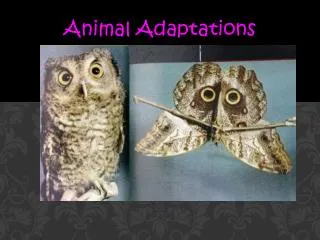
Mimicry • Mimicry is a physical adaptation that makes an animal look, smell, or sound like another animal to appear more dangerous or less appetizing to a predator. • This increases the animals chance of survival. • Which photo is of a bumble bee and which is of a Robber Fly? http://www.google.com/imgres?imgurl=http://www.alleghany.k12.va.us/animal%2520adaptation%2520webpage/images/18_beemimic.jpg&imgrefurl=http://www.alleghany.k12.va.us/animal%2520adaptation%2520webpage/animal_mimicry.htm&h=261&w=383&sz=33&tbnid=ujcdXQoR_9pToM:&tbnh=84&tbnw=123&prev=/images%3Fq%3Danimal%2Bmimicry&usg=__l4wv3tEhZ8WApJXyXTu858nFdTs=&ei=btHpS6CmLcGAlAfZ0LiKCw&sa=X&oi=image_result&resnum=3&ct=image&ved=0CCAQ9QEwAg
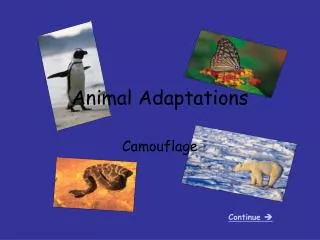
Camouflage • Camouflage is a physical adaptation of an animal’s body in color and/or shape so that the animal blends into its surroundings and is hard to see. • These animals are less likely to get caught. http://www.exzooberance.com/virtual%20zoo/they%20swim/harp%20seal/Harp%20Seal%20485028.jpg
Hibernation • Hibernation is an animal behavior in which the animal slows down its bodily functions and becomes dormant, which is like a sleeping state. http://www.topnews.in/files/Mini-hibernation.jpg
Migration • Migration is an animal behavior in which the animal travels from one place to another, usually for better food supplies but also for reproduction and/or safety. http://www.google.com/imgres?imgurl=http://audubonoffloridanews.org/wp-content/uploads/2009/11/bird-migration.jpg&imgrefurl=http://audubonoffloridanews.org/%3Fp%3D3314&usg=__1FBRkwSMmOe6eJaqOA84-OVp30A=&h=288&w=523&sz=17&hl=en&start=1&um=1&itbs=1&tbnid=fFBGE_vuwrECHM:&tbnh=72&tbnw=131&prev=/images%3Fq%3Dbird%2Bmigration%26um%3D1%26hl%3Den%26client%3Dfirefox-a%26sa%3DX%26rls%3Dorg.mozilla:en-US:official%26ndsp%3D20%26tbs%3Disch:1