

SlideServe
Menu
Préférences
© SlideServe · v2026

Animal Adaptations

erika avatar
21 diapositives · 1.5K Views · Mar 07, 2011

Animal Adaptations. Compiled by Angel Van Horn Copernicus Project / RCOE from Utah Education Network. Have stiff spines that stick out from their bodies and help protect them. Have loose skin under those spines and powerful back muscles. Why? . African Hedgehog.
Animal Adaptations - slide 1
01 / 21Animal Adaptations
1 / 17

Télécharger la présentation

Animal Adaptations
Une image / un lien ci-dessous est fourni (tel quel) pour télécharger la présentation

Politique de téléchargement : le contenu du site vous est fourni TEL QUEL pour votre information et votre usage personnel ; il ne peut être vendu, concédé sous licence ni partagé sur d’autres sites sans l’accord de son auteur.Le contenu vous est fourni TEL QUEL, pour votre information et votre usage personnel uniquement. Téléchargez la présentation en cliquant sur ce lien. Lors du téléchargement, si vous ne parvenez pas à télécharger une présentation, l’éditeur a peut-être supprimé le fichier de son serveur.Pendant le téléchargement, si vous ne parvenez pas à obtenir une présentation, le fichier a peut-être été supprimé par l’éditeur.

F I N

Plus de contenu associé

Transcription de la présentation
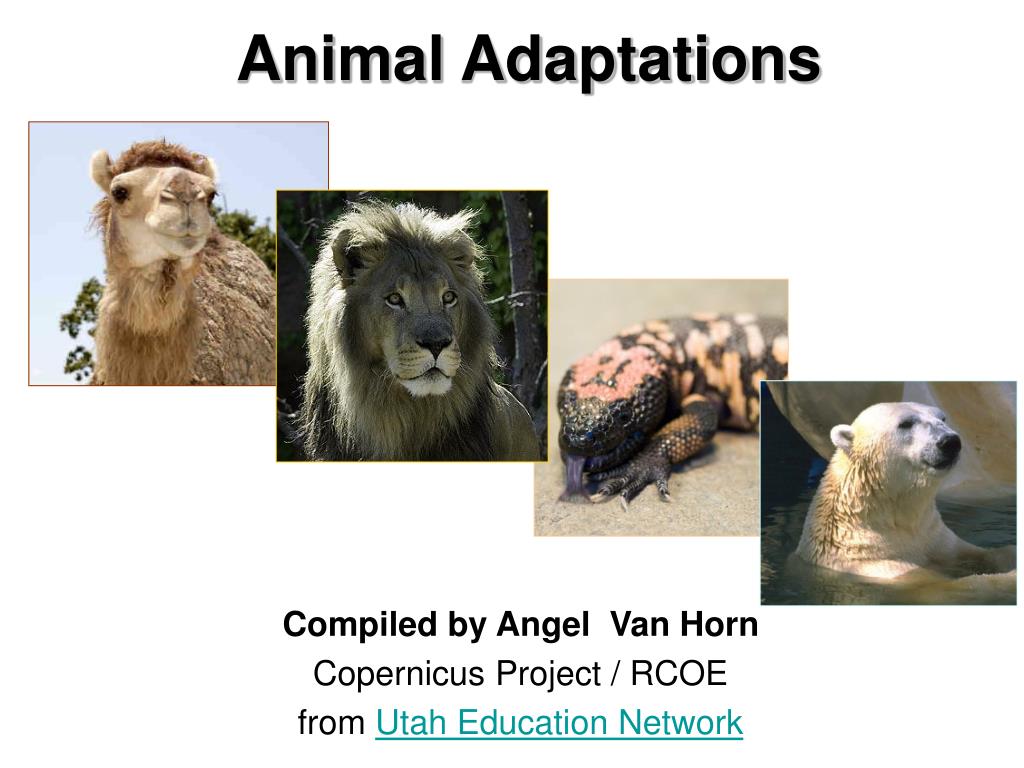
  1. Animal Adaptations Compiled by Angel Van Horn Copernicus Project / RCOE from Utah Education Network

  2. Have stiff spines that stick out from their bodies and help protect them. Have loose skin under those spines and powerful back muscles. Why? African Hedgehog

  3. How are these alligator's eyes adapted for seeing in water? North American Alligator

  4. What is the purpose of the mane on a male lion? Why are the eyes of a lion set in the front of its head rather than on the sides? A lion has heavily muscled forelimbs and shoulders. Why? Why do they have forepaws equipped with long, retractile claws? Why do they have a rough tongue? Why do they have loose belly skin? African Lion

  5. Camels have many adaptations that allow them to live successfully in desert conditions. Do you know what they are? Bactrian Camel

  6. Koala • How are the hands of a koala adapted for life in a tree?

  7. Sea otters spend almost their entire lives in water. They eat, sleep, and even have their babies in water. How is their fur adapted to keep them warm? Why is it a critical situation when otters encounter oil spills? What do they eat? Sea Otters

  8. How are the mouths of pythons adapted to finding prey and swallowing large prey? Burmese Python

  9. Why do many monkeys and apes have long arms? Describe special adaptations on the hands of Gibbons. White-Cheek Gibbon

  10. What do they eat? How do they hold on to prey that is struggling to escape? Burrowing Bullfrog

  11. Why can king snakes eat rattle snakes? California King Snake

  12. How are beavers built for underwater work? Beavers

  13. How long are they? What do they eat? How are their mouths adapted to what they eat? White Throated Savanna Monitor

  14. Why are giraffes able to go for long periods of time without water? How are their long necks adapted to their lifestyle? Giraffe

  15. How are the heads of vultures adapted to what they eat? Lappet-faced Vulture

  16. What special adaptations do manatees have that allow them to stay under water longer than the average land-dwelling mammal? Manatees

  17. Wallaroo • What do they eat? • How are their feet adapted to rock climbing?

  18. Why do polar bears have such big feet? How does their fur keep them warm? Polar Bears

  19. How are platypuses adapted for the time they spend in water? Platypus

  20. What do Gila Monsters do to avoid the heat of the day? What do Gila Monsters do in winter months to keep warm? How do they survive during winter months with little food? Gila Monster

  21. Additional Resources • http://www.veeriku.tartu.ee/~ppensa/animal_adaptation.html