Introduction to the Muscular System
110 likes | 233 Vues
Dive into the fascinating world of the muscular system! This introduction covers the three main types of muscles: skeletal, smooth, and cardiac. Learn about skeletal muscles that enable voluntary movement and facilitate activities like walking and dancing. Discover the endurance and involuntary nature of smooth muscles found in internal organs, and explore the unique properties of cardiac muscle that keep the heart beating continuously. Understand muscle pairs, their roles in movement, and how muscle cells function and rest.


Introduction to the Muscular System
E N D
Presentation Transcript
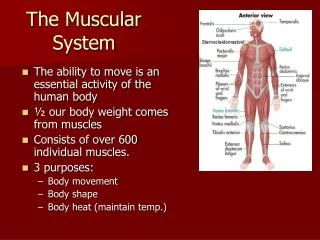
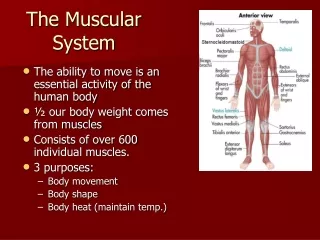
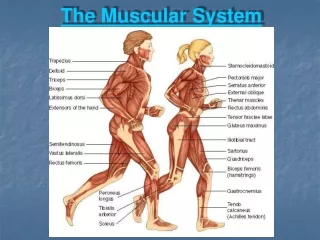
Muscle Types • Skeletal – Moves bones • Smooth – moves internal organs • Cardiac – moves heart
Skeletal Muscles • Enable movement by pulling bones • Made mostly of proteins • Striated – lines or stripes on tissue that make it strong and enable it to contract • Exert large forces for a short period of time • Strong but get tired easily • Voluntary
Skeletal Muscle types • Flexors and extensors - work in opposing pairs - one contracts and the other relaxes - responsible for gross motor movement like dancing, walking, - responsible for fine motor movement like writing, painting, playing video games
Skeletal Muscle Types • Levators and Depressors - levator = lifting - depressors = bringing back down
http://health.howstuffworks.com/human-body/systems/musculoskeletal/adam-200006.htmhttp://health.howstuffworks.com/human-body/systems/musculoskeletal/adam-200006.htm
Smooth Muscle • Not striated • Apply weaker forces • Have great endurance – can work for a long period of time without a lot of rest – digestion can take up to 8 hours! • Involuntary • Found in the internal organs – digestive organs and blood vessels
Cardiac Muscle • Some striations • Found ONLY IN THE HEART! • Strong force and great endurance • Continuously working!!!