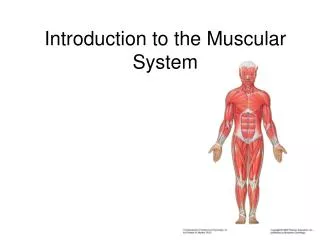
Introduction to the Muscular System
150 likes | 452 Vues
The muscular system is essential for movement, composed of skeletal muscle fibers organized into fascicles. Muscle classification includes parallel (e.g., biceps brachii), convergent (e.g., pectoralis major), pennate, and circular (e.g., orbicularis oris). Each muscle has an origin, the fixed attachment, and an insertion, the movable end. Muscles are named based on location, origin and insertion, fascicle orientation, relative position, structure, and action. Understanding muscle organization and function is crucial for studying human anatomy and physical movement.


Introduction to the Muscular System
E N D
Presentation Transcript
Organization of Skeletal Muscle Fibers • muscle • fascicles • fibers • fibers of a single fascicle always parallel • fascicles of a muscle can be arranged in various ways
Muscles are classified by how the fascicles are organized • Parallel (e.g., biceps brachii muscle) • most common arrangement • Convergent (e.g.,pectoralis muscle) • fascicles fan or triangle shaped, converge to attach
Muscles are classified by how the fascicles are organized • Pennate(unipennate, bipennate and multipennate) • fasicles form angle toward tendon • Circular (e.g.,orbicularis oris) • sphincter, contracts to reduce diameter of opening
Origins and Insertions • The ends of skeletal muscles are always attached to other structures • fixed end is called ORIGIN • usually attached to bone or cartilage • movable end is called INSERTION • usually attached to the bone it moves
How are muscles named? • location in the body • e.g., temporalis muscle • Origin and Insertion • first part = origin, 2nd part = insertion • Fascicle Organization • e.g., Rectus means “straight” • e.g., transverse means “across” • e.g., oblique means “oblique angle”
How are muscles named? • Relative Position • e.g., superficialis, internus, lateralis, etc… • Structural Characteristics (shape and size) • e.g., deltoid, rhomboid, major, longus, etc… • Action • e.g., abductor, extensor, rotator, etc…
Characteristics of Muscle • Skeletal and smooth muscle are elongated • Muscle cell = muscle fiber • Contraction of a muscle is due to movement of microfilaments (protein fibers) • All muscles share some terminology • Prefixes myo and mys refer to muscle • Prefix sarco refers to flesh
Muscular Actions • Agonists (prime mover) • responsible for a particular movement • Antagonist • against movement of agonist • Synergists • aid agonists, stabilize an action • Fixators • specialized synergists • immobilize the origin of agonist so all tension is exerted at the insertion point