Digital Certificate Operation in a Complex Environment
This presentation, part of the Digital Projects in Oxford series, details the implementation and evaluation of digital certificate services at the University of Oxford. We explore the development of a Public Key Infrastructure (PKI), usability challenges, and issuing mechanisms, such as registration and renewal processes. Key findings from stakeholder consultations reveal varying levels of security expectations and usability preferences. We aim to balance high security with ease of use, addressing psychological factors influencing acceptance. Follow our progress for a comprehensive understanding of digital certificates in education.

Digital Certificate Operation in a Complex Environment
E N D
Presentation Transcript
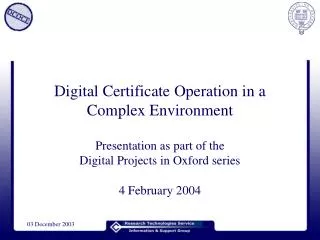
Digital Certificate Operation in a Complex Environment Presentation as part of theDigital Projects in Oxford series4 February 2004
Digital Certificate Operation in a Complex Environment • What a mouthful. …bless you! • What are we trying to do? • “To provide a detailed implementation and evaluation report of 'real world' digital certificate services at the University of Oxford” • Attempt to learn from the experience of others • Development/implementation of, a public key infrastructure… • Evaluations • Dissemination
The staff The aims What ARE digital certificates? Summary of PKI What have we done so far? A few findings from our consultation Questionnaire results A few soft findings A bit of psychology Our challenges (And see our glossary) This talk
Staff • Project team: • Project Manager: Mark Norman • Evaluators: Alun Edwards (OUCS), Johanneke Sytsema (SERS) • Systems Developer: Christian Fernau • Project Board: • Mike Fraser/Paul Jeffreys (Co-Project Directors) • Frances Boyle (SERS)
The aims (in short…) • Use digital certificates for authentication at Oxford (and elsewhere) • Involves ‘building’ a PKI and • making some services ‘certificate aware’ • Look at usability and issuing mechanisms • Registration, renewal, revocation etc. • Have an open mind about the success • Maybe balance the high security (potential) with ease of use/implementation… …pragmatism?
What ARE digital certificates? • Lots of jargon: • X.509 • Public key infrastructure • Signing, encryption, hashes • Where have you seen them before? • Secure Sockets Layer (SSL) • (DCOCE is about personal certificates) • But what are they? • Little bits of digital information that are signed by a trusted authority
What have we done so far? • Stakeholders and consultees • Found out about other PKIs • Designed a few bits of ‘architecture’ to stimulate discussion • Held a consultation meeting • Where we presented those ‘bits’ • Analysed the feedback • Used the feedback to design the architecture • And begin coding
A few findings from our consultation • What we did on the day: • PKI preamble (primer talk) • About the project • Talk from Athens • Describe our ‘ideas’ • Discuss the ideas • Talk (contextualise) our questionnaires • Complete questionnaires • Further discussion
Our ideas (briefly…) • Basic level assurance • For most University users • Medium level for the Grid and others • How to scale the registration • Trusting the registration servers • Generating keys locally • Being secure • Mobility problems • Save certs and private keys on a central server? • Or use ‘devices’?
Some results from the questionnaires • 2 questionnaires • Service/security people • Users/user reps • About 10 of each • A lot of ‘noise’!
A few findings (preliminary) • From the users/support staff
A few findings (preliminary) • From the service/security staff
A few findings (preliminary) • From the service/security staff
A few findings (preliminary) • From the service/security staff
A few findings (preliminary) • From the service/security staff
A few soft findings • Should try to use a devolved system of RAs (i.e. Colleges) • Security ‘experts’ sceptical of man in the middle • Very suspicious of the flaws in the PKI • Although questionnaire responses said that the PKI should be transparent/unseen/easy • Everyone heaped extra requirements • No relationship between the answer of level of security and their expectations of the PKI
A bit of psychology • We don’t need high levels of security • However, when people hear PKI, they then want it
Our biggest challenge • Persuading people that PKI is a good idea • Why do it – people don’t want extra security? • (But service providers need it)
Follow our progress (or otherwise) at http://www.dcoce.ox.ac.uk