Download

1 / 4
40 likes | 55 Vues
NFL Injectable Cavity Fire Barrier 2022

E N D
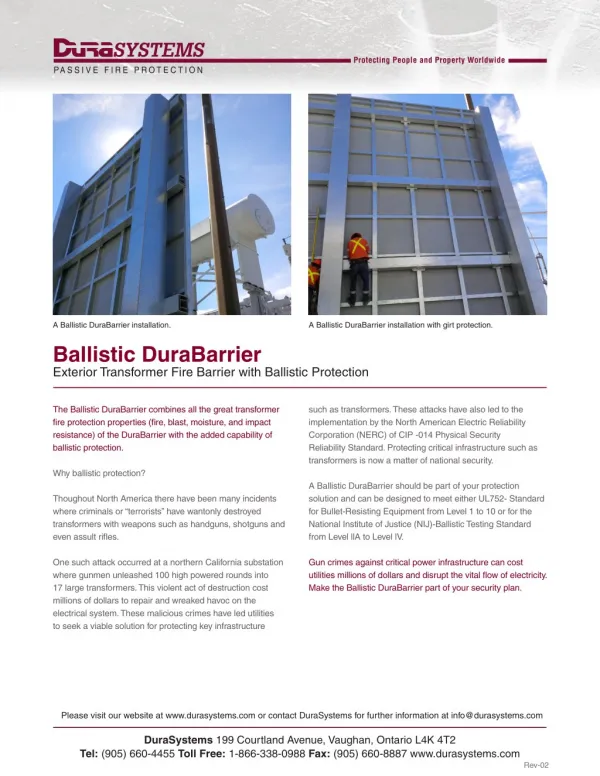
Injectable Cavity Fire Barrier The retrospective cavity fire barrier solution 0845 430 6600 info@nationalfireltd.co.uk www.nationalfireltd.co.uk
National Fire Ltd are one of the early approved adopters for an external passive fire protection cavity fire barrier solution to an issue that many building owners/occupiers are unaware that they have. The government is constantly looking at the adequacies & inadequacies of the UK’s fire safety regulations and making updates & changes where required, publishing new standards for building owners & occupiers to comply with and are actively pursuing enforcement of such regulations. Much of the UK’s current building stock unfortunately does not comply with many aspects of the Regulatory Reform Order (RRO) and other such important Fire safety legislation. THE PROBLEM Many UK properties are built using a steel frame shell and concrete slabs to separate different floors. All new buildings that are being newly constructed in a compliance with the UK’s fire safety & building regulations but a very high number of existing properties are unfortunately still not compliant. Once the frame is erected either metal cladding or two layers of brick work are used to create what we see at the completed façade of a building. The main issue in achieving compliance with fire safety regulations in this scenario is that to date, it has been very difficult and very expensive to retrofit cavity fire barrier’s to an external cavity once a building is completed and occupied. In this scenario a fire could break out on any particular floor and travel upwards to the next floor via the metal cladding or cavity within the brickwork. Fire regulations are very clear in that a “Fire Compartment” must include floors & Ceilings but also the walls either side. Most people understand that fire compartmentation requires passive fire protection between floors but the external walls however are still a part of a fire compartment and need to be protected. Traditionally, to achieve a tested fire barrier an expensive scaffold would have needed to be erected and cladding or outer layer of brickwork would need to be removed, fire cavity barrier installed and brickwork replaced. This solution comes with both a heavy capital outlay and significant disruption to the building occupiers. Insufficient cavity barriers can lead to combustible gases, flames & smoke spreading between floors! 0845 430 6600 info@nationalfireltd.co.uk www.nationalfireltd.co.uk
THE SOLUTION Cost saving & Quick to Install National Fire Ltd have a solution to this problem that is both cost effective and requires little disruption to building occupiers by providing our injectable cavity fire barrier service. THE PROCESS Our injection equipment which is either trailer mounted or installed in a standard small commercial vehicle so its straight forward and easy to set up. Our injectable cavity fire barriers as the name suggests are is simply injected from our specialised equipment on the ground floor and externally pumped into the cavities of a property which will form create a passive cavity fire barrier to each fire compartment separately. The process is quick, less disruptive and significantly more cost effective than the traditional method. Fully tested & approved by Warrington Fire, a third-party testing house, this solution can ensure your property is fully complaint with fire regulations without the massive capital outlay normally required. PRODUCT BENEFITS Normally 1 or 2 bricks are required to be removed every linear metre eliminating the need to remove large sections of the building’s façade 1 PIR Insulation can be left in place Horizontal or vertical installation types available Steel pins are fixed at regular intervals between the openings 2 Substantial cost savings A supporting membrane is laid into the cavity and supported by the steel pins 3 Fully tested & approved Rapid installation and certification Intumescent graphite sealant is injected into the cavity to form an approved cavity fire barrier 4 Tested to BSEN: 1366-4 up to 2hr integrity & Insulation BSEN 1366-4 Causes no known affects to plastic, sheathing or metallic components Measurements are taken and recorded for quality assurance 5 Smoke, gas, water and air tight 6 Openings are re-fitted and made good Fungi and vermin resistant Certificate of conformities can be issued to the client. 7 Water soluble & odourless 0845 430 6600 info@nationalfireltd.co.uk www.nationalfireltd.co.uk
EXAMPLES OF A TYPICAL INJECTABLE FIRE BARRIER INSTALLATION Plasterboard Partition Plasterboard Partition Floor Slab Floor Slab Injectaclad Fire Barrier System Injectaclad Fire Barrier System External Facade External Facade Fig 1. Injectaclad system fitted without existing insulation installed Fig 2. Injectaclad system fitted with existing insulation installed Who needs to ensure compliance with Fire safety legislation • measures for securing that, at all material times, the means of escape can be safely and effectively used; In a business-to-business scenario specifically it is the “Responsible person” that is required to ensure the building is compliant with fire regulations • measures in relation to the means for fighting fires on the premises; • measures in relation to the means for detecting fire on the premises and giving warning in case of fire on the premises; and The Fire Regulatory Reform order (FRRO) describes the Responsible person as:- • measures in relation to the arrangements for action to be taken in the event of fire on the premises, including— Meaning of “responsible person” 3. In this Order “responsible person” means— • measures relating to the instruction and training of employees; and in relation to a workplace, the employer, if the workplace is to any extent under his control; • measures to mitigate the effects of the fire. in relation to any premises not falling within paragraph (a)— the person who has control of the premises (as occupier or otherwise) in connection with the carrying on by him of a trade, business or other undertaking (for profit or not); or Duty to take general fire precautions 8. (1)—The responsible person must— the owner, where the person in control of the premises does not have control in connection with the carrying on by that person of a trade, business or other undertaking. • take such general fire precautions as will ensure, so far as is reasonably practicable, the safety of any of his employees; and We therefore strongly recommend that if you are in any doubt of who is responsible for fire safety compliance in your building that you obtain clarification without delay. • in relation to relevant persons who are not his employees, take such general fire precautions as may reasonably be required in the circumstances of the case to ensure that the premises are safe. If you are the responsible person you are required under the FRO to:- With strong interest already received by our existing clients, demand for our injectable cavity fire barrier system (also known as Injactaclad) is high, we are already seeing this solution being the “go to” system to resolve non-compliance with cavity fire barriers in existing buildings. Meaning of “general fire precautions” 4. (2)—measures to reduce the risk of fire on the premises and the risk of the spread of fire on the premises; • measures in relation to the means of escape from the premises; 0845 430 6600 info@nationalfireltd.co.uk www.nationalfireltd.co.uk