Understanding Conic Sections: Parabolas, Ellipses, and Hyperbolas
This text explores the fundamental concepts of conic sections, focusing on parabolas, ellipses, and hyperbolas. A parabola is defined as the set of points equidistant from a fixed point (focus) and a fixed line (directrix), with the vertex being crucial to its shape. An ellipse is characterized by the constant sum of distances from two fixed points (foci), while hyperbolas are defined by a constant difference of distances from two fixed points. These geometrical figures are pivotal in various mathematical and real-world applications.

Understanding Conic Sections: Parabolas, Ellipses, and Hyperbolas
E N D
Presentation Transcript
10.5 CONIC SECTIONS Spring 2010 Math 2644 Ayona Chatterjee
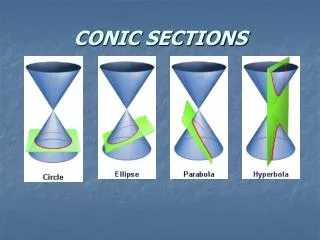
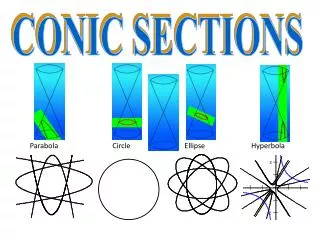
Conic sections result from intersection a cone with a plane.
PARABOLAS • A parabolas is the set of points in a plane that are equidistant from a fixed point F (called the focus) and a fixed line (called the directrix). • The point halfway between the focus and the directrix lies on the parabola and is called the vertex.
ELLIPSES • An ellipse is the set of points in a plane the sum of whose distances from two fixed points F1 and F2 is a constant.
Terms The points (a,0) and (-a,0) are called the vertices. The line segment joining the vertices is called the major axis.
HYPERBOLAS • A hyperbola is the set of all points in a plane the difference of whose distances from the two fixed points F1 and F2 (the foci) is a constant. • Hyperbolas is similar to an ellipse, the one change is that the sum of distances has become difference of distances.