

SlideServe
Menu
Préférences
© SlideServe · v2026

Hydration

drago avatar
18 diapositives · 508 Views · Jul 19, 2014

Hydration. Fluid – the forgotten nutrient. Humans contain 30-50 litres of water. We lose water through sweat, urine and evaporation. Water turn over varies between athletes. Turnover increases during exercise and hot conditions. Effects of Dehydration. Impaired Performance
Hydration - slide 1
01 / 18Hydration
1 / 17

Télécharger la présentation

Hydration
Une image / un lien ci-dessous est fourni (tel quel) pour télécharger la présentation

Politique de téléchargement : le contenu du site vous est fourni TEL QUEL pour votre information et votre usage personnel ; il ne peut être vendu, concédé sous licence ni partagé sur d’autres sites sans l’accord de son auteur.Le contenu vous est fourni TEL QUEL, pour votre information et votre usage personnel uniquement. Téléchargez la présentation en cliquant sur ce lien. Lors du téléchargement, si vous ne parvenez pas à télécharger une présentation, l’éditeur a peut-être supprimé le fichier de son serveur.Pendant le téléchargement, si vous ne parvenez pas à obtenir une présentation, le fichier a peut-être été supprimé par l’éditeur.

F I N

Plus de contenu associé

Transcription de la présentation
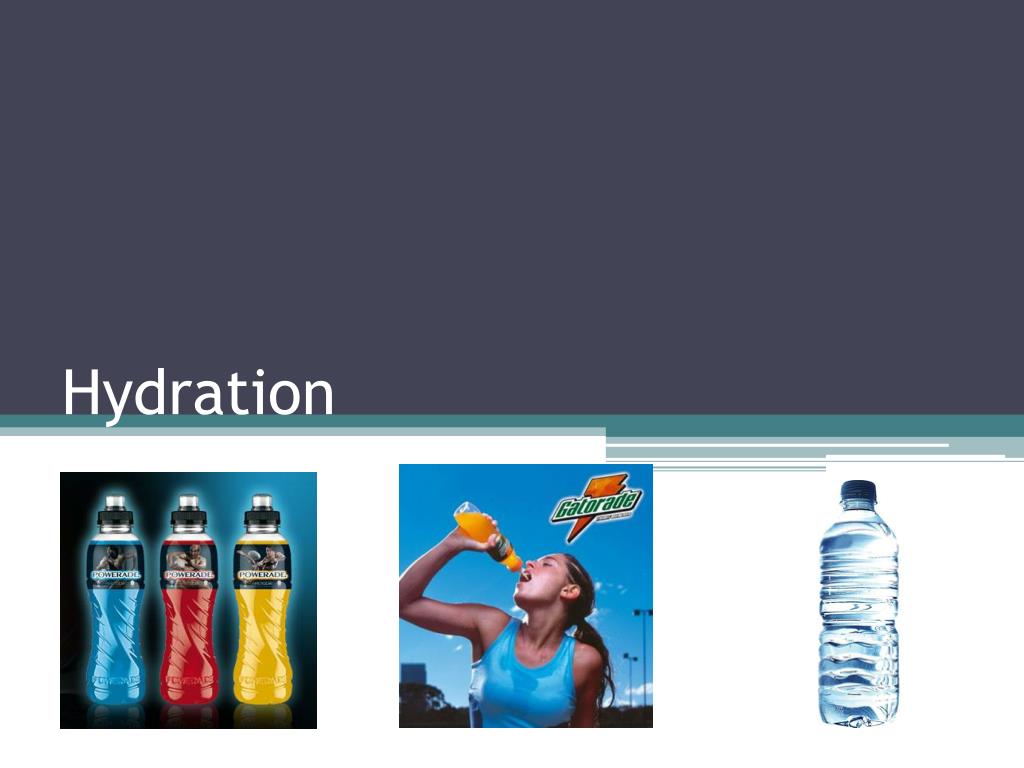
  1. Hydration

  2. Fluid – the forgotten nutrient • Humans contain 30-50 litres of water. • We lose water through sweat, urine and evaporation. • Water turn over varies between athletes. • Turnover increases during exercise and hot conditions.

  3. Effects of Dehydration • Impaired Performance • By 10-20% with ~2% of body weight • Impaired Mental Function • Slowing reaction-response times • Decision making skills • Increased risk of heat cramps, exhaustion and stroke • >3% fluid loss

  4. Monitoring Hydration • Urine Colour chart

  5. Monitoring Hydration cont... • Hydration Monitor – Refractomer • Weight Flactuation – Before and after exercise • E.g. Athlete consumed 1L fluid during exercise but lost 1kg in weight from sweating. • Total sweat loss = 2L

  6. Case Study - Mark • Mark is a central forward • Participates in a high intensity 90minute soccer training session • Pre-training weight = 75kg • Drinks 1.5L during training • Post-training weight = 73kg • To avoid dehydration and over-hydration, how much fluid should Mark consume during his next training session?

  7. Case Study - Mark • Weight loss = 75-73kg = 2kg (~2L) • % weight loss = 2/75kg= 2.7% (dehydrated) • Total sweat loss = 2L weight loss + 1.5L drank during training = 3.5L • Allowable sweat loss = 2% x 75kg= 1.5L • Minimum fluid replacement = 3.5 – 1.5L = = 2L over 90 mins =~300mls per 15 minutes • Maximum fluid replacement = 3.5L = 3L over 90 minutes = 450mls per 15 minutes • Recommended Intake for Mark ~ 300-450mls/15min

  8. What type of Fluids? Drink water if • Exercise <30 minutes • Low intensity exercise • If high intensity > 30-60mins and cannot tolerate sports drinks – need to take CHO and sodium in another form

  9. Sports Drinks • Provide: • Carbohydrate for extra energy • Fluid for hydration • Electrolytes e.g. sodium • Choose according to requirement for: • Fluid • Carbohydrate • Fluid and carbohydrate • Electrolytes

  10. Hypotonic Sports Drinks • Contain less than 6g CHO/100ml • Used when wanting to replace more fluid than CHO • Can be beneficial in hot climate with little physical activity.

  11. Isotonic Sports Drinks • Contain 6-8g CHO/100ml • Used when wanting to replace fluids and CHO equally • Generally most effective choice in most situations. E.g. Team sports and individual sports.

  12. Hypertonic Sports Drinks • Contain more than 8g CHO/100ml • Used when wanting to replace more CHO than fluid. • Suitable for cold climates where dehydration is not a problem but large energy expenditure. E.g. Cross country skiing, Mountaineering.

  13. What affects fluid intake? • Athletes awareness of their sweat losses • Awareness of disadvantages of dehydration • Dislikes taste/sensation • Availability of fluid • Stomach comfort • Fear of weight gain • Fear of need to urinate during exercise • Lack of practice

  14. Developing a Fluid Plan Pre Exercise/Event • Well hydrated before exercise • Drink fluids regularly throughout the day leading up to training/event • Have drink with meals and snacks • Fluid choice • Any fluid during the day to make up 2L and meet CHO requirements • Isotonic/Hypotonic/water in 1-2h prior to training/event

  15. Developing a Fluid Plan During Exercise/Event • Fluid choice • Generally isotonic • If cannot tolerate – hypotonic/water & CHO food • 150-200mls every 10-15 minutes as a guide but really should match individual athletes sweat loss • Depends on practicalities of your sport • Practice fluid replacement plan in training

  16. Developing a Fluid Plan Post Exercise/Event • Fluid choice • Generally Isotonic • If cannot tolerate then hypotonic/water plus CHO foods with salt • 1 kg body weight lost = 1L fluid loss • Aim to drink 1.5 x fluid loss over 2-4hrs after event

  17. Intravenous Drips • Used to rehydrate players during competition or to aid recovery afterwards. • Athletes report faster recovery rates. • Athletes can be given a known amount of fluids and carbohydrate and can be consuming these while resting or sleeping.

  18. Arguments – for and against