Enhancing Performance Through Advanced Training Theory and Individual Adaptation
170 likes | 322 Vues
This overview delves into the critical components of training theory, focusing on principles such as overload, accommodation, specificity, and individualization. It highlights the importance of adjusting training loads to exceed habitual levels for optimal adaptation. The dual concepts of variability and specificity are discussed to ensure effective programming while avoiding adaptive stagnation. Additionally, the significance of transfer of training results is explored, along with the impact of genetic factors on muscle adaptation. This comprehensive approach ensures safer and more effective training outcomes.


Enhancing Performance Through Advanced Training Theory and Individual Adaptation
E N D
Presentation Transcript
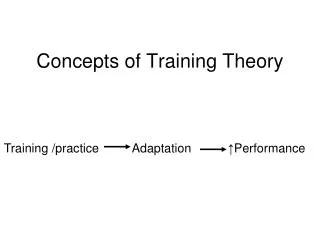
Concepts of Training Theory Training /practice Adaptation ↑Performance
Nutrition Theory Design Testing Safety
Adaptation • Stimulus magnitude (overload) • Accommodation • Specificity • Individualization • Context (e.g. training state) • External vs. internal factors
Overload • Training load above habitual level • Includes volume and intensity overload
Accommodation • Response to a constant stimulus is reduced over time (adapted) • Lack of an overload
Specificity • Perhaps the most important concept of training • Training must be as close to main sport exercise in muscular coordination and physiological demand • Since training rarely is exactly like performance, transfer of training results has to be considered
Estimating transfer • First standardize a training result Result gain = gain in performance SD of performance • Then calculate the transfer Transfer= Result gain in nontrained exercise Result gain in trained exercise Zatsiorsky, 2006 Science and Practice of Strength Training
Variability in transfer • Transfer in athletes/trained individuals is low • Sedentary/beginners have a high degree of transfer where all exercises are useful • Highest transfer occurs with highly specific exercises
Conflict of Accommodation and Specificity • Training programs should be variable to avoid accommodation and stable to satisfy the need for specificity
Individualization • Main variables of individuality are • Training history • Training state • Internal factors • External factors • Genetics
Strength Responder (3X F) Dual Responder (2X F) Non Responder (2X M) Muscle Responder (3X M)
“Double-Muscled” Animals Belgian Blue bull: genetic mutation resulting in increased number and size of muscle fibers
“Double-Muscled” Animals Genetically engineered mouse that does not produce myostatin, which turns off muscle development in the fetus and inhibits muscle growth after birth.
“Double-Muscled” Humans? Do heavily muscled humans have the genetic mutation that suppresses myostatin production?
Interference • Concept of types exercises performed together causing reduced adaptation