Vietnam War Draft and Protests: From Controversy to Legacy
Explore the impact of the Vietnam War draft, protests, Tet Offensive, political turmoil, Nixon's strategies, Kent State tragedy, Pentagon Papers, and the war's lasting legacy.

Vietnam War Draft and Protests: From Controversy to Legacy
E N D
Presentation Transcript
Chapter 22 sec 3-5 Vietnam
Draft • Males = 18-26 • Lottery System • Manipulatable system • Medical exemptions • Change residents = draft board • National Guard • Deferment from Vietnam • College • Working class war • Minorities / Lower class • Racial tensions War
1965 = 20,000 March on Washington • 1967 = ½ Million New York Central Park • “Burn cards, not people” • “Hell, no, we won’t go!” • Burned draft cards • 1970 = Nixon phases out draft Protests
200,000 accused of draft offenses • 4,000 imprisoned • 10,000 Fled = Canada • Muhammad Ali • http://www.youtube.com/watch?v=HeFMyrWlZ68 • Hawks v. Doves • Protests acts of disloyalty?? • 70% believed it to be Un-American Protests Cont.
VIETNAM, CH 22 Section 4
Tet • Lunar New Year (Jan 30) • Truce • War funerals • Tet Offensive • Vietcong launch attack on over 100 towns and 12 U.S. air bases • Takes U.S. a month to regain control of towns • 32,000 Vietcong die • 3,000 U.S/ARVN die • Shook American public • 60% of Americans dissaproved • Johnsons handling of war 1968
Eugene McCarthy • Senator • Runs on anti-war platform • Robert Kennedy • At first, isn’t going to run • After McCarthy holds his own in primary against Johnson, Bobby changes his mind • Hubert Humphrey • Johnson’s Vice-President Election of 1968/Democratic Party
April 4, 1968 • Martin Luther King assassinated • June 5, 1968 • Robert Kennedy assassinated Tragedy
August 28, 1968 • Protesters converge in Chicago at Democratic National Convention • Nixon wins Republican candidacy • Nixon wins the Presidential Election in November Presidential Election
Nixon and Vietnam Section 5
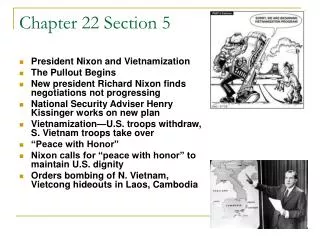
Henry Kissinger • National Security Advisor to Nixon • Vietnamization • Gradual withdrawal of U.S. troops so the South Vietnamese could take on a more active combat role • August, 1969, first 25,000 troops head home • Over the next three years, less than 25,000 remain by 1971 Vietnamization
Nixon wanted to maintain U.S. dignity during withdrawal • He secretly ordered bombing of Laos and Cambodia • Vietcong strongholds • Silent Majority – Nixon’s belief that the moderate, mainstream Americans supported war • Even as troops coming home from Vietnam, Nixon announces invasion of Cambodia The WAR continues
Seymour Hersch • New York Times reporter • March 16, 1968 • U.S. platoon under command of Lt. William Calley, Jr. ordered to “kill anything that breathed” • Over 200 innocent women, children, elderly killed My LAI
April 30, 1970 • Nixon orders invasion of Cambodia • To clear out VC • College students burst out in protests • Kent State University • Protesters burn ROTC building • National Guard fires on crowd • 9 wounded, 4 killed • Jackson State College • 12 wounded, 2 killed Protests http://www.youtube.com/watch?v=vyzoNCJvy4c
Leaked by Dept. of Defense worker Daniel Ellsberg • 7,000 documents that laid out the plans of U.S. entering Vietnam War • Hurt Nixon administration • Confirmed the growing belief that the American people couldn’t trust the government Pentagon Papers
March, North Vietnam launch massive attack on South • Nixon responds with bombing campaign • October, Kissinger secretly meeting with Le DucTho (N.V. negotiator) for last year, drops demand the North withdraw • Last bombing on Hanoi and Haiphong, 100,000 bombs • Moscow, Beijing, Congress say ENOUGH • March 29, 1973 Last of U.S. troops come home 1972 Election/Nixon wins
Americans • 58,000 killed • 303,000 wounded • Vietnamese • Over 2 million killed • North and South • Government abolishes draft • War Powers Act • President must inform Congress within 48 hours of troop deployment • 90 days or less • American foreign policy altered • …pause, consider risks • People NO LONGER TRUST government Legacy of Vietnam War