Heredity
Discover the basics of heredity through Gregor Mendel's groundbreaking pea plant experiments on traits, genotype, and phenotype inheritance. Understand inheritance patterns, probability, and genetic terminology in an engaging and informative manner.

Heredity
E N D
Presentation Transcript
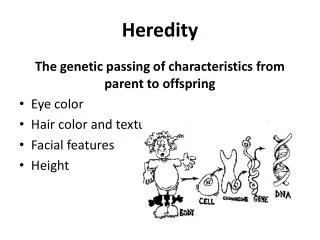
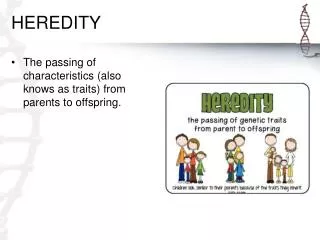
Your Physical Appearance • Heredity is the passing of traits from parents to an offspring. • Gregor Mendel was the first scientist to successfully study inheritance • He is the “Father of Genetics”
Why Pea Plants? • Mendel use Garden Pea Plants for his research because: • They grow quickly • They naturally self-pollinate
Mendel’s Success • Mendel was successful with his pea plant research because: • he studied one trait at a time! (independent variable) • He had studied statistics *A trait is a distinct phenotypic characteristic that may be inherited
Pea Plant Traits • Flower Color • Flower Position • Seed Color • Seed Shape • Pod Shape • Pod Color • Plant Height
The Experiment • Mendel began by taking pure trait plants and cross-pollinating them • He did this by hand, not with bees!
The Experiment Part I (Example 1) Plant height Mendel crossed a Tall parent plant with a short parent plant: Tall x short = All Tall TT x tt = Tt parent 1 x parent 1 = First Filial (F1) Both parent plants were true-breeding: They always produced the same type of offspring.
The Experiment Part I (Example 2) Flower Color Mendel crossed a Purple parent plant with a white parent plant: Purple x white = All Purple PP x pp = Pp parent 1 x parent 1 = First Filial (F1)
The Experiment Part II • He wondered why one trait disappeared when he crossed the two pure (true-breeding) plants • He decided to allow the new F1 plants to naturally self-pollinate and here is what he found……..
Example 1- Plant Height F1 Tall plants self-pollinate and produce: 75% Tall Plants 25% short plants
Example 2 - Flower Color F1 Purple Flower color plants self-pollinate and produce: 75% Purple flowers 25% white flowers
Mendel’s Conclusion • The Principle of Dominance and Recessiveness states that one trait is more likely to occur than the other. • Dominant is a trait that is most likely to occur • Recessive is a trait that is usually hidden in the first generation, but may reappear later
Probability • The chance or possibility that a certain outcome will occur. Usually written as: • Fractions • Decimals
Genotype- the genetic make-up of an organism (TT, Tt, tt) Phenotype- the physical appearance of an organim (Tall, short, Purple, white) Dominant- more likely to occur (The tall plants or the purple flowers) Recessive- less likely to occur (The short plants or the white flowers) Let’s Learn a New Language..
Let’s Learn a New Language.. • Homozygous- when both alleles are the SAME • Homozygous Dominant: TT, PP, WW • Homozygous Recessive: tt, pp, ww • Heterozygous- when each allele is DIFFERENT • Tt, Pp, Ww
Let’s Learn a New Language.. • An Allele is an alternate form of a gene; one part of a pair • A Gene is composed of two alleles, one from each parent Allele + Allele = Gene T(mom) + t(dad) = Tt(child)
Punnett Squares • Developed by Rudolph Punnett to make genetics easier for us to understand
Genetics Example 1 In garden pea plants, tall plants are dominant (T) and short plants are recessive (t). A pea plant that is homozygous dominant for height is crossed with one that is homozygous recessive for plant height. • Draw a Punnett square to represent the problem. • What are the possible genotypes? • What are the possible phenotypes? • What is the probability of each genotype? • What is the probability of each phenotype?
Genotypes • Phenotypes • Probability of genotypes • Probability of phenotypes
Genetics Example 2 In garden pea plants, purple flower color (P) is dominant over white flower color (p). A pea plant that is homozygous recesive for flower color is crossed with one that is heterozygous for flower color. • Draw a Punnett square to represent the problem. • What are the possible genotypes? • What are the possible phenotypes? • What is the probability of each genotype? • What is the probability of each phenotype?
Genotypes • Phenotypes • Probability of genotypes • Probability of phenotypes
Genetics Examples In garden pea plants, yellow seeds (Y) are dominant and green seeds (y) are recessive. What offspring would result if two heterozygous plants were crossed? • Draw a Punnett square to represent the problem. • What are the possible genotypes? • What are the possible phenotypes? • What is the probability of each genotype? • What is the probability of each phenotype?
Genotypes • Phenotypes • Probability of genotypes • Probability of phenotypes
Incomplete Dominance • Sometimes one trait is not completely dominant over the other • The same letter allele is used • Red x White = Pink RR x R’R’ = RR’ • This results with a combined genotype • Snap dragons
Codominance • Sometimes both traits are equally dominant • Different letter alleles are used • Black x White = Checkered BB x WW = BW • This results in both traits being expressed • Checkered Chickens
Alternate forms of Genetics • Gregor Mendel studied simple genetic inheritance: • Offspring were either dominant or recessive • But not all traits are simple!!
Thomas Hunt Morgan • Studied Fruit Flies • Discovered • Gender inheritance • Other traits associated with gender
Gender • Gender is always determined by the male
Sex-linked Traits • Some traits are only located on the “X” chromosome • Since Males only have one “x” chromosome, they are more likely to show the trait than a female with two “x” chromosomes
Sex-linked Traits • Colorblindness • Hemophilia • Muscular dystrophy