Essential Skills and Aptitudes for Success in School Plays and Beyond
60 likes | 175 Vues
Participating in a school play requires a diverse set of skills, including reading, critical thinking, memorization, teamwork, and public speaking. These skills are not only essential for performance but are also transferable and applicable in various contexts, such as English classes or choir. Understanding aptitudes—natural talents that come easily—helps identify personal strengths. Skills can be categorized into basic, social, complex problem solving, technical, systems, and resource management. Distinguishing between roles (personal identities) and occupations/vocations (career paths) is crucial for personal development.


Essential Skills and Aptitudes for Success in School Plays and Beyond
E N D
Presentation Transcript
Often One Task Uses Many Different Skills… • If James acted in a school play, what skills would be required? • Read the play (reading) • Interpret the play (critical thinking) • Memorize • Cooperate with others (teamwork) • Project his voice (public speaking) • Perform in front of hundreds of people (public speaking)
Many of these Skills are… • Transferable: They can be applied to other situations. • Example: English class or choir.
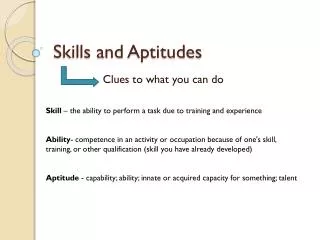
Aptitude • Something that you have a natural talent for or something that comes easy to you.
Skills Divided into Six Categories • Basic Skills • Social Skills • Complex Problem Solving Skills • Technical Skills • Systems Skills • Resource Management Skills
Roles, Occupations and Vocations • A role is what you are (son, daughter, sister, brother, friend, etc.) • An occupation or vocation refers to what you do. • Occupation is paid employment. • Vocation is more like a special skill. (student)