Using Randomness for Coherent Quantum Control
This study explores the advantages of using randomization in quantum control, particularly in situations involving large control groups, long time intervals, and rapidly fluctuating interactions. It identifies cases where random protocols are more effective than deterministic ones, emphasizing the benefits of combining both approaches (hybrid protocols). The results highlight that randomized control can enhance performance, especially under fast oscillating couplings. This work underscores the potential of integrating randomness in quantum decoherence suppression techniques.

Using Randomness for Coherent Quantum Control
E N D
Presentation Transcript
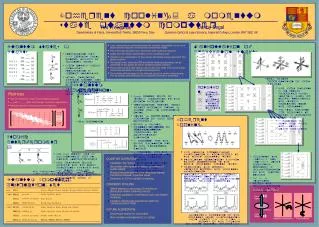
Randomization may be more advantageous when i) large control groups/ long time intervals and/or ii) rapidly fluctuating interactions Viola & Knill, PRL 94, 060502 (2005) • Single qubit: decoherence suppression • Identify situations where a random protocol is more suitable • combining protocols leads to a better performance Santos & Viola, forthcoming Using Randomness for Coherent Quantum Control Lea F. Santos and Lorenza Viola Department of Physics and Astronomy Dartmouth College • Deterministic vs. RANDOM dynamical decoupling
Interaction picture: Decoherence function in the absence of control, Ohmic bath: system-bath interaction strength High T Low T bath temperature bath correlation time Decoherence from a Quantum Bosonic Environment Model is exactly solvable
Goal: Average out the interaction with the environment Bang-Bang: Arbitrarily strong and instantaneous control operations drawn from a group Sequences of bang-bang operations + free evolutionsDecoupling if + - Low T Cyclic dynamical scheme: High T Deterministic Dynamical Decoupling Viola & Lloyd, PRA 94, 060502 (1998) Viola et al, PRL 82, 2417 (1999)
pulse Naïverandom protocol: at (PAREC method) Hybrid protocol:combines deterministic and random protocols (embeds a deterministic scheme into a stochastic one) Acyclic. Toggling/logical frame – evolution follows the applied control Random Dynamical Decoupling
* * High T Low T + + deterministic hybrid no control random Deterministic vs. Random Decoupling: Numerical Results Fixed time interval: i) large number of control pulses: all protocols are equivalent ii) small number of control pulses: hybrid may perform better
* * High T deterministic no control random Time-Dependent Coupling Random pulses may be safer
Conclusions • Comparison between deterministic and RANDOM dynamical decoupling • for a single qubit + quantum environment • There are situations where • combined protocols (deterministic + random) • may perform better (hybrid protocol) • randomized control is more recommendable • [when the coupling is fast oscillating, for example] • Further work is necessary to expand the analysis • References: • L. Viola and S. Lloyd, PRA 94, 060502 (1998) • L. Viola, E. Knill and S. Lloyd, PRL 82, 2417 (1999) • L. Viola and E. Knill, PRL 94, 060502 (2005) • O. Kern , G. Alber and D. L. Shepelyansky, Eur. Phys. J. D 32, 153 (2005) • O. Kern and G. Alber, quant-ph/0506038 • L. F. Santos and L. Viola, forthcoming