Download

1 / 16
160 likes | 307 Vues
This introduction to fibers explores their fundamental characteristics, including fineness, flexibility, and high aspect ratio. It addresses the ambiguity of measuring fiber dimensions, introducing linear density as a measurement that combines fineness and mass density. The text details measurement systems like denier, tex, and decitex, illustrating how they reflect the same fiber's properties. Additionally, the importance of flexibility and the factors affecting it are discussed. Future topics on chemical properties and strength will follow, enhancing our understanding of both natural and manufactured fibers.

E N D
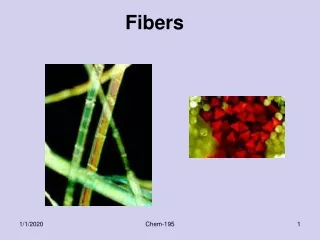
What is a fiber? • Fine • Flexible • High Aspect Ratio (length-to-width ratio)
How fine is fine? • To get around the ambiguity of diameter (in the case of nonround fibers) or thickness (in the case of irregular shapes) fineness is often expressed in units of linear density . • In its most simple form, linear density is merely the weight of a fixed length of fiber.
Systems of Measurement • There are three major systems used to measure linear density, denier, tex, and decitex (or dtex). They're all equally good (or bad depending upon your point of view!), but they are not consistently used. • The only difference among them is the fixed length. • The oldest is denier, the accepted SI unit is decitex.
[1] Named after the small silver coin the denarius used as a weight standard. [2] With apologies to purists, weight and mass are used interchangeably—Every field has its embarrassments. [3] Not named for the second largest state or any of its inhabitants
A word of caution • There's another thing to keep in mind when using linear density—it combines both the fineness (cross-sectional area, actually) and the mass density—more later.
Thought experiment • Let's conduct a small 'thought experiment', suppose we take the time to unwind 1000 meters of a fiber (shape is unimportant), and we take this fiber and weigh it; suppose it weighs 1 gram. • 1000 m weigh 1 gram linear density = 1 tex • 9000 m would weigh 9 grams 9 denier • 10000 m would weigh 10 grams 10 dtex • Same fiber, just different systems of measurement.
An example • Find the linear density, in denier, of a fiber for which 500 m weigh 2 grams • W = 2 g • L = 500 m • λ[den] = 2 g x 9000 m/g / 500 m = 36 • [note, all of the units 'cancel out']
For a round fiber only Where r is the mass density of the fiber * But not all fibers are round
Flexibility • Ease of bending • What is its cause? • Material • Fineness • Inversely proportional to the fourth power of the diameter • So if we have a two fibers with identical composition, but Fiber A has twice the diameter of Fiber B, Fiber A is 16 times (24) less flexible than Fiber A. • Length
High Aspect Ratio • How high is high? • Usually l/d > 1000
What’s next? • Next time we’ll look at some of the properties of the more important of these fibers • Chemical structure • Affinity to moisture • Strength • Stiffness
Where can I get a copy of this? • http://schwartz.eng.auburn.edu/2270