Understanding Consumption and Investment Decisions in a Two-Period Fisher Model
This document explores the dynamics of consumption and investment preferences within a two-period framework as established by Fisher. It covers key concepts such as indifference curves, diminishing marginal utility, investment opportunity sets, and the relationship between demand and supply in the loanable funds market. The impact of capital market opportunities on budget lines is analyzed, along with the implications of interest rate spreads on social welfare. Additionally, it addresses how market equilibrium for interest rates is derived, emphasizing the aggregation of individual supply and demand schedules.

Understanding Consumption and Investment Decisions in a Two-Period Fisher Model
E N D
Presentation Transcript
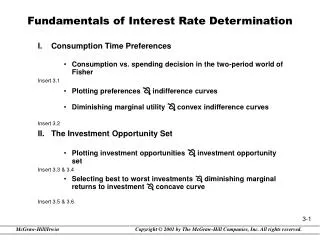
I. Consumption Time Preferences • Consumption vs. spending decision in the two-period world of Fisher • Insert 3.1 • Plotting preferences Ô indifference curves • Diminishing marginal utility Ô convex indifference curves • Insert 3.2 • II. The Investment Opportunity Set • Plotting investment opportunities Ô investment opportunity set • Insert 3.3 & 3.4 • Selecting best to worst investments Ô diminishing marginal returns to investment Ô concave curve • Insert 3.5 & 3.6 Fundamentals of Interest Rate Determination
III. Capital Market Opportunities and Budget Lines • Capital market opportunity lines Ô Budget lines • Insert 3.7 • Horizontal intercept = Present value • Insert 3.8 • Vertical intercept = Future value • With capital markets everyone is at least as well off as before, and some are better off. • Insert 3.9 • Capital flows from savers to investors to maximize total wealth. Both sides gain. How is this possible? Question: Suppose we were to look at emerging markets in this way. What are the implications? Question: What happens in this framework when a disaster strikes a region or a country?
A. Interest rate spreads The effect of different borrowing and savings rates • Insert 3.10 • Question: What is the implication of rate spreads on social • welfare? What is the gain from their elimination? • B. Market equilibrium for interest rates • Deriving supply and demand curves in a two-person world • Insert 3.11 • Aggregating individual supply and demand schedules • Insert 3.12 Ô economy-wide supply and demand schedules Ô economy-wide supply and demand intersection Ô equilibrium interest rate • IV. The Aggregate Loanable Funds Market Comprised of individuals, firms or governments, each with their own demand and supply curves for loanable funds • Insert 3.13
V. Summary • Interest rates affect individual decisions on consumption / saving • Capital markets improve utility • Loanable funds approach to interest rate determination • Aggregating across individuals yields market demand and supply for credit Ô equilibrium interest rate