The Integumentary System
The integumentary system, encompassing skin, nails, and hair, serves vital functions in regulating body temperature, protecting against environmental damage, and facilitating sensory perception. The skin, or cutaneous membrane, comprises two main layers: the epidermis, which contains keratinized cells and provides protection, and the dermis, a connective tissue layer rich in nerve endings. Key cell types include keratinocytes, melanocytes, Langerhans cells, and Merkel cells. This system also plays a crucial role in Vitamin D synthesis and excretion, maintaining overall homeostasis.

The Integumentary System
E N D
Presentation Transcript
Integumentary System • The Body Covering • Includes: Skin, Nails & Hairs • Skin A.K.A. Cutaneous Membrane • Functions: • Body Temperature Regulation: Sweating at surface and adjusting blood flow in dermis. • Protection: Keratin protects from microbes, abrasions, heat and chemicals, lipids slow evaporation of water, melanin protects from UV rays. • Cutaneous Sensations: Sensory input/output • Excretion and Absorption: Eliminates substances, passage of materials into body cells (drugs) • Synthesis of Vitamin D: UV light activates creation of Vit D
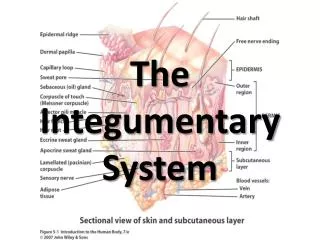
Structure • Skin is divided into two main parts: • Epidermis(epi = above) Surface epithelial layer • Dermis: Deeper connective tissue layer • Subcutaneous Layer Deep dermis not part of the skin. • Fibers from dermis anchor skin to this layer which then allows for attachment to other tissue and/or organs.
Epidermis • Made of keratinized stratified squamous epithelium • Capable of regeneration (new cells ~ q4 weeks) • 4 cell types: • Keratinocytes: 90% of epidermal cells, 4 – 5 layers, produces keratin (rough fibrous protein that protects skin), waterproofs skin. • Melanocytes: 8% of epidermal cells, produce the pigment melanin, transfer melanin to kertinocytes, susceptible to UV light damage. • Langerhanscells: Produce immune response against pathogens entering skin. • Merkelcells: Detect touch/sensory sensations.
Dermis • Consists of two distinct regions: • The superficial part is composed of areolar connective tissue. • The deeper partis composed of dense irregular connective tissue. • Attaches to the subcutaneous layer. • The outer layer contains nerve endings for touch, thermal sensations, pain, tickling, and itching.
Skin Color • Skin color is due to the melaninin the epidermis, carotene in the dermis, and hemoglobin in the capillaries of the dermis. • Melanin (Brown-Black pigment) • Darkness depends on amount of melanin produced. • Gives some protection against UV • Malignant melanoma, (cancer of the melanocytes), is a particularly serious skin cancer. Liver or age spots, are non-cancerous clusters of melanin. • Carotene (Yellow-Orange pigment) • In deeper skin and adipose layers • Hemoglobin (Pink-Red pigment) • Found in blood • Depends on blood flow
Review • What are the 5 functions of skin? • What are the two main parts of skin called? • What 4 cells make up the superficial/thinner part of the skin? • What is the function of the subcutaneous layer? • Which skin layer contains nerve endings? • What pigments contribute to skin color? • The shade of your skin depends on what factor? • What are the characteristics and functions of keratinocytes?