The Knee Joint
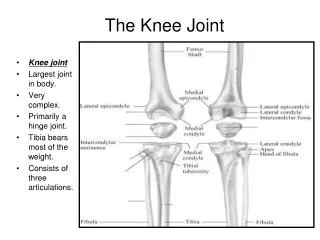
The Knee Joint. Largest and Most Complex Joint. Structure of the Knee. Lateral and Medial Epicondyles on both femur and tibia Tibial Tuberosity front of tibia

The Knee Joint
E N D
Presentation Transcript
The Knee Joint Largest and Most Complex Joint
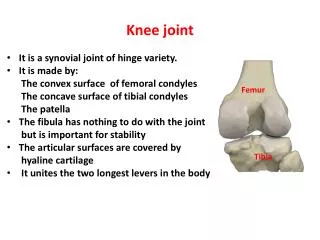
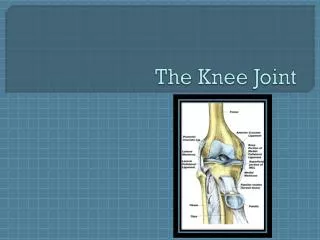
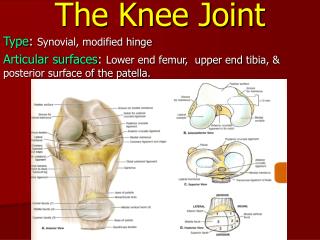
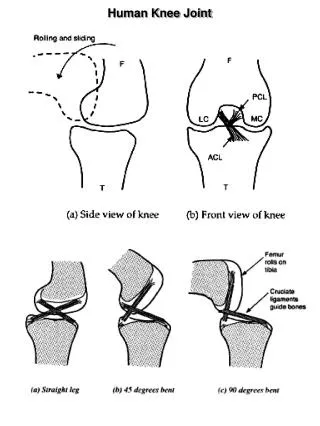
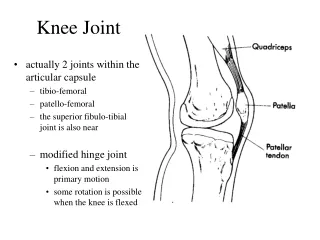
Structure of the Knee • Lateral and Medial Epicondyles • on both femur and tibia • TibialTuberosity • front of tibia • Patellofemoral Joint – patella held in place by the quadraceptendon (above), patellar lig. (below), and intervening fibers that form a pocket • Medial and Lateral Condyle (femur) • Intercondylarfossa (femur) • Intercondylar eminence (tibia)
Menisci • Circular rims of fibrocartilage on the articular surfaces of the head of the tibia
Menisci • Thick on the outside – get thinner on the inside • Deepen the joint and serve as shock absorbers • Inner edges are free, but the other borders are attached loosely to the rim of the head of the tibia • Medial and Lateral Meniscus
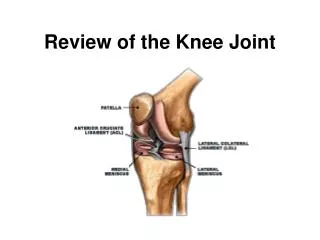
Ligaments • Patellar lig., Medial (tibial) Collateral lig., Lateral (fibular) Collateral lig., Oblique Popliteallig., Anterior Cruciatelig., Posterior Cruciatelig., Transverse lig., Iliotibial tract
Movements • Flexion and Extension • Inward and Outward rotation in the non-weight bearing flexed position
Muscles of the Knee Joint Anterior (Extension) Posterior (Flexion) Hamstring group Biceps femoris Semimembranosus Semitendinosus Sartorius Gracilis Popliteus Gastrocnemius • Quadracepsfemoris group • Rectus femoris • Vastusintermedius • Vastuslateralis • Vastusmedialis