Exploring Archaeology and Fossils: A Journey Through Time
In this engaging homework session, students will delve into the intriguing world of archaeology and fossils. Imagine leaving a shoe print in wet concrete and how future archaeologists might interpret it. Students will reflect on this scenario while studying vocabulary related to archaeological remains, excavation processes, and the significance of fossils. Through context sentences and activities, learners will grasp the importance of studying human history and the evidence left behind by past civilizations. Let’s uncover the mysteries of our planet’s history!

Exploring Archaeology and Fossils: A Journey Through Time
E N D
Presentation Transcript
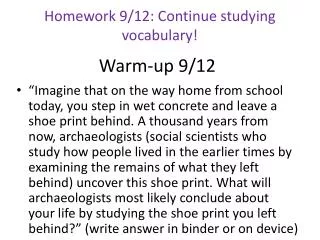
Homework 9/12: Continue studying vocabulary! Warm-up 9/12 • “Imagine that on the way home from school today, you step in wet concrete and leave a shoe print behind. A thousand years from now, archaeologists (social scientists who study how people lived in the earlier times by examining the remains of what they left behind) uncover this shoe print. What will archaeologists most likely conclude about your life by studying the shoe print you left behind?” (write answer in binder or on device)
Archaeologists have estimated that these prints are about three million years old. Refer to the whiteboard to complete the activity for this photo!
Fossils – Vocabulary Strategy Activity Context Sentence: A cretaceous shellfish fossil found in the chalk around Wilmington is on display at the museum.
Fossils • are the preserved remains of animals, plants, and other organisms from the past (usually in layers of rock)
Excavation – Vocabulary Strategy Activity Context Sentence: Recent archeological excavations show Mayan women are often buried with turquoise hair combs.
Excavation • excavation is the process of finding archaeological remains. An excavation site or "dig" is a site being studied.
Archaeology • The study of human history through discovery and exploration of artifacts • http://www.youtube.com/watch?v=3-a7nsRM1E8 (Bill Nye the Science Guy)