LAB Exercise II-12 Enzymes
E N D
Presentation Transcript
Biology 211 LabExercise II-12 Enzymes
What you need to know: • The student will describe the role of enzymes in chemical reactions and will know how enzyme activity can be altered by: • Concentration • pH • Temperature
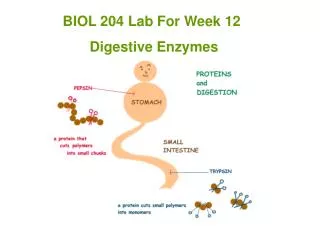
Chemical Digestion: Enzymatic Action • Because nutrients can only be absorbed when broken down to their monomers, food digestion is a prerequisite to food absorption • Enzymes are large protein molecules produced by body cells • They are biologic catalysts that increase the rate of a chemical reaction without themselves becoming part of product • Enzymes are highly selective, catalyzing specific reactions only • This specificity is due to the shapes of the enzyme molecules
Factors affecting catalytic activity of enzymes • Temperature • As the temperature rises, reacting molecules have more and more kinetic energy. • This increases the chances of a successful collision and so the rate increases. • There is a certain temperature at which an enzyme's catalytic activity is at its greatest • This optimal temperature is usually around human body temperature (37.5 oC) for the enzymes in human cells. • Above this temperature the enzyme structure begins to break down (denature) since at higher temperatures intra- and intermolecular bonds are broken as the enzyme molecules gain even more kinetic energy.
Factors affecting catalytic activity of enzymes • Temperature
Factors affecting catalytic activity of enzymes • pH • Each enzyme works within quite a small pH range • There is a pH at which its activity is greatest (the optimal pH) • This is because changes in pH can make and break intra- and intermolecular bonds, changing the shape of the enzyme and, therefore, its effectiveness.
Factors affecting catalytic activity of enzymes • Concentration of enzyme and substrate • The rate of an enzyme-catalysed reaction depends on the concentrations of enzyme and substrate • As the concentration of either is increased the rate of reaction increases • For a given enzyme concentration, the rate of reaction increases with increasing substrate concentration up to a point, above which any further increase in substrate concentration produces no significant change in reaction rate. • This is because the active sites of the enzyme molecules at any given moment are virtually saturated with substrate. The enzyme/substrate complex has to dissociate before the active sites are free to accommodate more substrate. • Provided that the substrate concentration is high and that temperature and pH are kept constant, the rate of reaction is proportional to the enzyme concentration
Factors affecting catalytic activity of enzymes • Concentration of enzymes and substrates