The Research Process in Psychology: Final Lecture and Course Review
This final lecture covers topics such as reviewing the literature, formulating testable hypotheses, designing research, collecting and analyzing data, interpreting results, and presenting research. It also includes a course review for the final exam.

The Research Process in Psychology: Final Lecture and Course Review
E N D
Presentation Transcript
The research process Psych 231: Research Methods in Psychology
This is the final lecture • Thursday (optional) – Review Q&A, help with posters, etc. • Turn in extra-credit journal summaries (and make sure that your SONA credits are assigned where you want them) • Labs this week • Poster presentations • Turn in group ratings sheets • Turn in the GP: results and discussion sections Announcements
Presenting your work • A set of skills leading to knowledge & understanding • A way of thinking (beware small samples, correlation is not causation, etc.) • A way of life? Get an idea Stats.org: Stats in the news Course Review: The Research Process
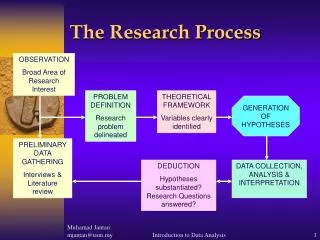
Get an idea • Often the hardest part • No firm rules for how to do this • Observations • Past research • Review the literature The Research Process
Review the literature • What has already been done? • What variables have people looked at • What hasn’t been looked at • How are other experiments in the area done? • What methods are used? • To measure the dependent variable • To manipulate the independent variable • To control extraneous variables The Research Process
Formulate a testable hypothesis • What is a hypothesis? • A predicted relationship between variables • What does it mean to be testable? • Must be falsifiable • Can it be replicated • Must be able to observe/measure (and manipulate for experiments) the variables • Directly • Indirectly • Operational definitions The Research Process
Design the research • What method? • Experiment, Survey, Developmental designs, … • What kind of comparisons are used • Control groups • Baseline conditions • What are your variables? • How many levels of your Independent variable(s) • How do you measure your dependent variable(s) • What can be done to control for biases and confounds? The Research Process
Collect Data • Importance of pilot research • Who do you test? • What is your population? • Your sample? • Your sampling method? The Research Process
Analyze the data • Design drives the statistics • Understanding Variables and variability • Descriptive statistics (summarizing) • Means, standard deviations • Graphs, tables • Correlation • Inferential statistics (drawing conclusions) • What kind of analysis is appropriate for your design • T-tests • ANOVA • Between or within versions The Research Process
Interpret the results • Correlation versus causation • Reject or fail to reject null hypotheses • Statistical vs. theoretical significance • Support or refute the theory (or revise) • Generalizability of the results The Research Process
Present the results • Getting the research “out there” • Conference presentations • Posters • Talks • Written reports • APA style • Supports clarity The Research Process
Research Presentations • (typically 10 to 30 mins) • Paper with respondent • Panel Presentation • Workshop Different kinds of talks
Create a logical progression to the talk • Hourglass shape • Work on the transitions between slides • Be brief, but include enough details so that the audience can follow the arguments • Use slides to help simplify/clarify points • Include tables, graphs, pictures, etc. • Don’t just read the slides • but do “walk through” those that need it (e.g. graphs of results) • Be careful of jargon, explain terms (if in fact you really need them) Talk Content
Make it smooth (lots of practice will help) • Watch your speaking rate (again, practice) • Maintain eye contact with whole audience • Emphasize the key points, make sure that the audience can identify these • Point to the slides if it helps • Beware jokes, can be a double-edged sword • Don’t go over your time Presentation of the talk
Repeat the question in your own words • so that the rest of the audience can hear it • to make sure that you understood the question • to buy yourself some time to think about the answer • Try not to be nervous • you know your study better than anyone else • When preparing, try to think of likely questions and prepare answers Dealing with questions
Repeat • Each set of results leads to more research questions • Refine the theory • Test a refined theory • Test alternative explanations The Research Process
Tues @ 3:10P • It is cumulative, covers the entire course. The majority is on new material (roughly 65%), the rest is material covered on Exams 1 & 2. • All multiple choice/scantron for the final Reviewing for the final exam
Final 1/3 of the course • Non experimental methods • Survey, correlational, & developmental • Statistics • Descriptive • Inferential • Presentations • Papers, Posters, & Talks Reviewing for the final exam
First 2/3 of the course • Scientific method • Getting ideas • Developing (good) theories • Reviewing the literature • Psychological Science • Ethics • Basic methodologies • APA style • Underlying reasons for the organization • Parts of a manuscript • Variables • Sampling • Control • Experimental Designs • Vocabulary • Single factor designs • Between & Within • Factorial designs Reviewing for the final exam