Volcanoes
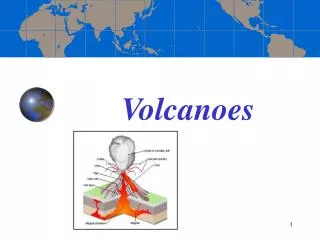
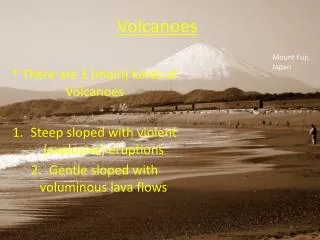
Mount Fuji, Japan's highest peak, is a prime example of a stratovolcano, known for its steep slopes and violent explosive eruptions. It comprises layers of lava and pyroclastic materials, with gas-rich andesitic magma that can lead to dangerous and viscous lava flows. This iconic volcano is part of the Pacific "Ring of Fire," which hosts many active volcanoes. The type of eruptions is influenced by factors such as magma composition, temperature, and dissolved gases, distinguishing it from other volcano types like cinder cones and shield volcanoes.

Volcanoes
E N D
Presentation Transcript
Mount Fuji, Japan Volcanoes * There are 2 (main) kinds of Volcanoes Steep sloped with violent (explosive) eruptions Gentle sloped with voluminous lava flows
Steep Sloped Violent/Explosive • Composite Cone, Stratovolcano • Large, nearly symmetrical formed from layers of both lava and pyroclastic materials. Gas rich magma of andesitic composition, Dangerous, viscous lava flows, mostly located in the “Ring of Fire”. • Mt. Fuji, Mt. St. Helens • Cinder Cone • Composed of loose pyroclastic material and usually form from a single eruption. Short life and are usually smaller 30-300 meters. • Paricutin
Gentle Sloped voluminous lava flows • Shield volcano – broad, slightly dome-shaped. Most have grown from the deep-ocean floor to form islands. Form from the accumulation of fluid basaltic lavas • Hawaiian islands, Kilauea, Iceland
Factors that determine volcanic eruption type • Amount of dissolved gases in the magma • Temperature of the magma • Composition of the magma