Stars
Explore the fascinating world of stars, their evolution, and classification. This overview highlights how massive, luminous balls of plasma undergo thermonuclear fusion, leading to their brilliance. Learn about the spectral analysis of stars, which reveals their composition, luminosity, velocity, and mass. The Hertzsprung-Russell diagram illustrates the relationship between luminosity and temperature, classifying stars as main sequence, giants, supergiants, and white dwarfs. Understand that all stars share the same material, but differ in temperature and evolution stages.

Stars
E N D
Presentation Transcript
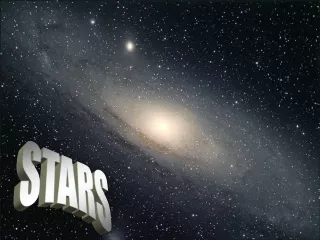
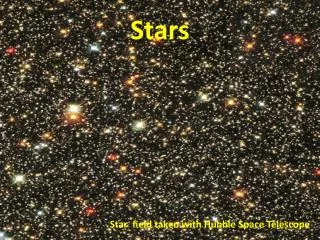
Stars Star field taken with Hubble Space Telescope
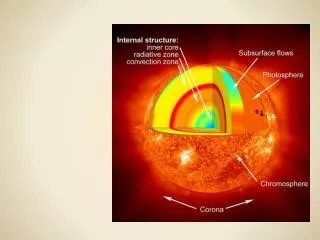
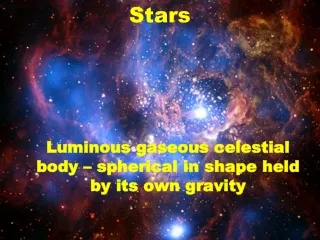
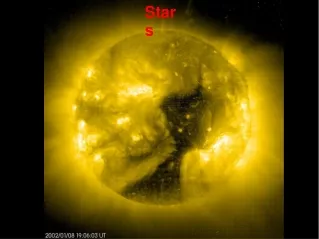
Star • Massive, luminous ball of plasma • Held together by gravity • Shines due to thermonuclear fusion of hydrogen in its core
Spectra of stars Allow astronomers to determine a star’s: • Composition • Luminosity • Velocity • Mass
Continuous- produced by a glowing body • Absorption line (dark line)- produced when a cooler gas lies between observer and glowing body – this is the type used to ID stars • Emission line (bright line)- emission from a glowing gas, used to study nebulae
Star classification • Stars are all made of the same material • Spectral differences are due to temperature
Classification system • O B A F G K M • O hottest • M coolest
H R (Hertzsprung Russell) Diagrams Stars plotted according to: • Luminosity (absolute magnitude) – brightest stars at the top • Temperature (spectral class) – hotter stars to the left
H R Diagram (cont.) • Main sequence • Band from hot (blue) to cool (red) • 90% of stars • e.g. the Sun • Giants • Luminous and cool • 10-100x size of the Sun • e.g. Aldebaranin Taurus
Super Giants • 1000x larger than the Sun • e.g. Betelguese in Orion Antares in Scorpius
White Dwarfs • Very hot, but low luminosity due to small size • e.g. Sirius B • NO fusion in core, glow due to contraction? Gravitational forces
Binary star • http://www.astronomy.ohio-state.edu/~pogge/TeachRes/Movies162/#spbin • http://www.calvin.edu/~lmolnar/anim/algol.html
Stellar Evolution • Stars do not live forever • Eventually nuclear fuel runs out and star dies
Stages of Stellar Evolution • Pre-main sequence • Stars form in a dense, cool cloud of dust and gas • Gravitational attraction causes it to start to glow • NO fusion yet Protostar