Increased CV risk( MI)for dentistry
360 likes | 507 Vues
This document explores the critical implications of cardiovascular disease (CVD) for dental professionals, focusing on conditions like congestive heart failure (CHF) and its associated risks during dental procedures. Key risk factors include previous myocardial infarctions, unstable angina, significant arrhythmias, and severe valvular disease. This summary includes the prevalence of CHF in the U.S., its symptoms and signs, complications, as well as recommendations for dental management considering a patient's cardiac status, to ensure safe and effective dental care.


Increased CV risk( MI)for dentistry
E N D
Presentation Transcript
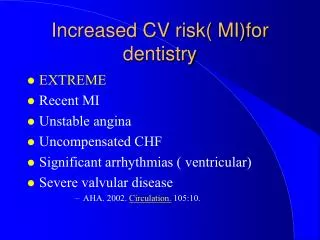
Increased CV risk( MI)for dentistry • EXTREME • Recent MI • Unstable angina • Uncompensated CHF • Significant arrhythmias ( ventricular) • Severe valvular disease • AHA. 2002. Circulation. 105:10.
Increased CV risk( MI) for dentistry • MODERATE • previous MI • ANY angina • ANY CHF ( walking flight of stairs) • ANY arrhythmias • IDDM • CVA • Renal disease • HTN -AHA. 2002. Circulation. 105:10. • Advanced age
CONGESTIVE HEART FAILURE • A symptom complex caused by or contributed by by several disorders • HTN > 75 % • ASCVD > 50% • RHD > 21% • severe= 40-60% 1 yr. Survival • MAY NOT BE DIAGNOSED ! • Spectrum of severity and morbidity
CONGESTIVE HEART FAILURE • U.S. > 2.5 million cases • 500,000 new cases per year • 50 % 5-yr. survival • 30-50% of deaths from CHF = sudden cardiac death • severe- 50 % have serious ventricular arrhythmias (COMPLICATIONS)
CONGESTIVE HEART FAILURE • COMPLICATIONS • infection • bleeding • MI • CVA • Cardiac arrest • Renal failure (Causes)
CONGESTIVE HEART FAILURE • Failure of the heart as a pump to provide adequate circulation to the body • chronic increase in cardiac load • damage to the myocardium • COMBINATION • Serious imbalance between hemodynamic load and capacity of the heart to handle it
CONGESTIVE HEART FAILURE • decreased myocardial function: ASCVD, MI, drugs, thyroid, amyloidosis • increased vascular resistance: HTN, aortic stenosis • increased blood volume: valvular insufficiency, renal failure • excessive metabolic demand: anemia, thyrotoxicosis
CONGESTIVE HEART FAILURE • SIGNS OF CHF • gallop rhythm • pulsus alternans • prolonged circulation time • polycythemia • cardiac enlargement
By far the most dangerous foe we have to fight is apathy - indifference from whatever cause, not from a lack of knowledge, but from carelessness, from absorption in other pursuits, from a contempt bred of self-satisfaction.Sir William Osler,1900
CONGESTIVE HEART FAILURE • SIGNS OF CHF • pulsus alternans = • alteration in stroke volume in every other cardiac cycle = low ejection fraction( ~15 % !) and advanced CHF • CHF indicator = ejection fraction
CONGESTIVE HEART FAILURE- SIGNS • ruddy color • clubbing of fingers • swollen ankles
CONGESTIVE HEART FAILURE- SIGNS • weight gain- girth • large tender liver • jaundice • cyanosis
CONGESTIVE HEART FAILURE • OTHER CLINICAL SIGNS • ascites • distended neck veins • peripheral edema • “pitting edema”
CONGESTIVE HEART FAILURE • SIGNS OF CHF • gallop rhythm • pulsus alternans • prolonged circulation time • cardiac enlargement
CONGESTIVE HEART FAILURE • COMPENSATORY ADJUSTMENTS • Increase peripheral resistance • increase blood flow to heart and brain • increase erythropoietic activity • Thrombocytopenia • polycythemia • Leukopenia (symptoms)
CONGESTIVE HEART FAILURE- SYMPTOMS • dyspnea • paroxysmal nocturnal dyspnea • periodic breathing- sleep apnea • insomnia • orthopnea • mental confusion • dizziness
CONGESTIVE HEART FAILURE- SYMPTOMS • weakness, fatigue • wheezing, coughing • low-grade fever, sweating • nausea, vomiting • cardiac reserve • epistaxis
CONGESTIVE HEART FAILURE • LABORATORY FINDINGS • Increased hematocrit, hemoglobin • decreased WBC • prolonged PT, PTT
CONGESTIVE HEART FAILURE • CLASSIFICATION • ventricular dysfunction • compensated CHF • intractable heart failure
CONGESTIVE HEART FAILURE • COMPLICATIONS • infection • bleeding • MI • CVA • Cardiac arrest
CONGESTIVE HEART FAILURE • DENTAL MANAGEMENT • nature and course of underlying cause(s) (i.e., RHD, CHD, ASCVD) • accompanying CVD ( i.e., Ischemic HD, arrhythmias, murmurs, etc.) • other systemic disease ( i.e. IDDM, etc.) • Ejection fraction
CONGESTIVE HEART FAILURE • DENTAL MANAGEMENT • HTN ! • BLEEDING • polycythemia • thrombocytopenia • low fibrinogen • PT, BT
Medical management of congestive heart failure. Pharmacologic treatment. NYHA class I CHF ( ejection fraction >40% ; asymptomatic patient)Long-acting ACE inhibitor
CONGESTIVE HEART FAILURE • MEDICAL MANAGEMENT for MILD CHF • decrease exertion; physical activity • loading dose of digitalis • cut down NaCl • drug side effects and interactions
CONGESTIVE HEART FAILURE • MANAGEMENT for MODERATE CHF • decrease exertion; physical activity • digitalis, diuretics, K+ • lasix, apresoline, isordil, minipress • COUMARIN • drug side effects and interactions
CONGESTIVE HEART FAILURE • MANAGEMENT for SEVERE CHF • decrease exertion; physical activity • digitalis, furosemide, ethacrynic acid • thiazide diuretics, triampterene • venous dilator for congestion • atrial dilator for weakness • NO ROUTINE DENTAL TREATMENT !!
Medical management of congestive heart failure Furosemide ( 20-120 mg) (watch for hypokalemia and gout)Long-acting ACE inhibitors( enalapril 5-10 mg 2 x/day) Potassium chloride supplementation (>4.0 mEq/L)Consider adding metozalone, 5-10 mg every other day (when furosemide dose exceeds 160 mg/day)
CONGESTIVE HEART FAILURE • DIGITALIS INTOXICATION • visual changes ( blurring) • nausea, vomiting, anorexia • fatigue, weakness, malaisse, drowsiness • headaches, neuralgias • delirium • ARRHYTHMIAS
CONGESTIVE HEART FAILURE • Complications from diuretics, vasodilators • Complications from ACEI • xerostomia, dehydration • nausea, vomiting, headaches • dizziness, weakness • orthostatic hypotension • lichenoid lesions • orthostatic hypotension
CONGESTIVE HEART FAILURE • lack of response to initial Rx= • POOR PROGNOSIS ( 50 % DIE in 5 yrs.)
CONGESTIVE HEART FAILURE • MEDICAL CONSUTLATION • establish : level of severity, underlying CVD, medications, level of control,contraindications, bleeding • CLOSE MONITORING !!! vitals, Rxs, etc. • Digitalis intoxication • orthostatic hypotension • careful with epinephrine
CONGESTIVE HEART FAILURE • MEDICAL CONSULTATION • COUMARIN- bleeding, PT and BT • ARRHYTHMIAS • short, non-stressful appointments • STOP if patient has symptoms !! • upright chair position • sedation ( N2O2)