Enhancing Recycling in Somerville: From Initial Programs to Sustainable Practices
In 1975, Somerville launched its first residential curb-side recycling program, collecting 8% of recyclable materials from refuse. As of 2005, the city decreased its total municipal solid waste (MSW) while implementing expanded recycling initiatives, including a variety of materials like all glass and plastics. Despite the success of new programs, only 11% of recyclable materials were being collected, improved to 23% with state credits. Future initiatives aim to increase participation through outreach, improved education, and targeted marketing to strengthen community involvement in waste reduction and recycling efforts.

Enhancing Recycling in Somerville: From Initial Programs to Sustainable Practices
E N D
Presentation Transcript
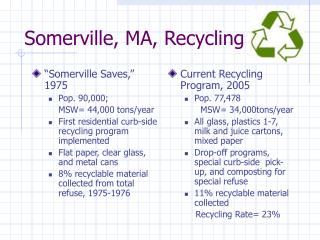
“Somerville Saves,” 1975 Pop. 90,000; MSW= 44,000 tons/year First residential curb-side recycling program implemented Flat paper, clear glass, and metal cans 8% recyclable material collected from total refuse, 1975-1976 Current Recycling Program, 2005 Pop. 77,478 MSW= 34,000tons/year All glass, plastics 1-7, milk and juice cartons, mixed paper Drop-off programs, special curb-side pick-up, and composting for special refuse 11% recyclable material collected Recycling Rate= 23% Somerville, MA, Recycling
Recycling Rate Equation • (Municipality’s total waste diversion + state credits for other recycling programs) municipality’s total waste generation • State credits= Recycling Programs • Composting Projects, Bins • Curb-side Computer / Television Monitor Pick-up • Christmas Tree and other Yard Waste Pick-up • State credits help double the Recycling Rate of Somerville, from 11% 23%
Increase Recycling Rate of Somerville • Strengthen Residential Curb-side Recycling Program • Develop “Pay-As-You-Throw” Program • Outreach to demographic that does not practice residential curb-side recycling • Education of the importance of recycling • Target specific demographics for “Marketing Recycling Programs,” such as the computer • Strengthen Special Recycling Programs • Market programs to specific demographics • Inform community of recycling options