B Physics at CDF
This presentation by Shin-Hong Kim at ICFP2003 discusses B-physics experiments conducted at the CDF detector in Fermilab's Tevatron collider, covering both Run I (1992-1996) and Run II (2001-present). It highlights the measurements of heavy flavor production, including the cross-sections of B-hadrons and the lifetimes of B mesons. Insights into anomalies in J/ψ production, challenges in triggering, and the implications for theoretical models such as the Standard Model are analyzed. The talk emphasizes the progress in integrated luminosity and the significance of these findings for future experiments.

B Physics at CDF
E N D
Presentation Transcript
B Physics at CDF Shin-Hong Kim (University of Tsukuba) October 9 , 2003 ICFP2003 at KIAS, Seoul
Tevatron pp Collider at Fermilab RunI (1992~1996) s = 1.8 TeV RunII(2001~) s = 1.96 TeV + Main Injector CDF √ Tevatron Ring √ Main Injector
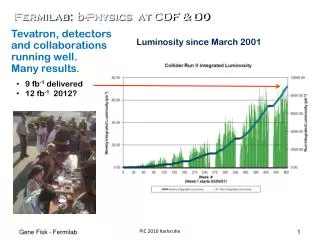
Tevatron Status 2002 2001 Initial Luminosity Run I(1992~1996): • Record Luminosity 2x1031 cm-2sec-1 • Integrated Luminosity 110 pb-1 on Tape Run II(2001~): • 5 x1031 cm-2sec-1(August 2003) • Integrated Luminosity 330 pb-1 • 270 pb-1on Tape • 120 pb-1analyzed Schedule: • 2 fb-1 (by the end of 2005) • 9 fb-1 (by the end of 2009) Now 2001 2002 330 pb-1 Integrated Luminosity Delivered 270 pb-1 On tape
Drift Chamber Muon System Central Calor. New Solenoid Old Partially New Time-of-Flight Plug Calor. Muon Silicon Microstrip Tracker Front End Electronics Triggers / DAQ (pipeline) Online & Offline Software
SVT incorporates silicon info in the Level 2 trigger… select events with large impact parameter! Uses fitted beamline impact parameter per track System is deadtimeless: ~ 25 sec/event for readout + clustering + track fitting 35mm 33mm resol beam s = 48mm Secondary Vertex B Lxy PT(B) 5 GeV Primary Vertex <Lxy>~450m -500 -250 0 250 500 SVT impact parameter (mm) d = impact parameter Silicon Vertex Trigger (SVT)
Advantage Enormous cross-section ~100 b total ~ 4 b “reconstructable” At 4x1031cm-2s-1 ~150Hz of reconstructable BB!! All B hadrons produced Bu,Bd,Bs,Bc,b,… Disadvantage Large inelastic background Triggering and reconstruction are challenging B Physics at Hadron Colliders b’s produced by strong interaction, decay by weak interaction
Tevatron B cross sections measured at √s =1.8TeV (Run I:1992-1996) consistently higher than NLO calculation Theoretical work is ongoing Fragmentation effects Small x, threshold effects Proposed beyond SM effects What can experiments do? Measure more cross sections √s =1.96 TeV go to lower pT(B) Look at bb correlations Measure the charm cross section Heavy Flavor Cross Sections (RunI) Integrated cross sections X X
Observation of Bc meson(RunI) Cross section times Branching ratio vs Lifetime Invariant mass of J/ψ+l in Bc→J/ψlν decay mode N(Bc)= 20.4+6.2ー5.6
Anomalous J/ψDirect Production (RunI) ●Cross section of J/ψ andψ(2s) direct production is larger than QCD theoretical prediction by a factor of 50. PRL 79 (1997) 572, PRL 79 (1997) 578 ● Polarization of J/ψ andψ(2s)disfavors the color octet model.
J/ψ production cross section ( RunⅡ) CDF measured the J/ψ cross section from PT > 0GeV/c by lowering the trigger threshold. Consistent with Run I Measurement in PT > 5GeV/c region. Need a comparison between this result and theoretical prediction in the PT < 5GeV/c region.
B Hadron Lifetimes • All lifetimes equal in spectator model. • Differences from interference & other nonspectator effects • Heavy Quark Expansion predicts the lifetimes for different B hadron species • Measurements: • B0,B+ lifetimes measured to better than 1%! • Bs known to about 4% • LEP/CDF (Run I) b lifetime lower than HQE prediction • Tevatron can contribute to Bs, Bc and b (and other b-baryon) lifetimes. Heavy Flavor Averaging Group http://www.slac.stanford.edu/xorg/hfag/index.html
1.51 0.06(stat.) 0.02 (syst.) ps B+, B0 Lifetimes in J/ Modes (B0) 1.63 0.05(stat.) 0.04 (syst.) ps (B+) • Trigger on low pTdimuons (1.5-2GeV/) • Fully reconstruct • J/, (2s)+ • B+ J/K+ • B0 J/K*, J/Ks • Bs J/ • b J/ Proper decay length:
Bs lifetime - PDG 1.461 ± 0.057 ps 1.33 ± 0.14(stat) ± 0.02(sys) ps Bs Lifetime Bs→J/ψΦwith J/ψ→μ+μ- and Φ→K+K- B+→ J/ΨK+, B0→J/ΨK*0check technique, systematics
primary Lxy p + bLifetime • Use fully reconstructedb J/with J/ + and p • Previous LEP/CDF measurements used semileptonicb cl • Systematics different 469 signal First lifetime from fully reconstructed Λb decay!
Measure masses using fully reconstructed BJ/X modes High statistics J/+ and (2s)J/+ for calibration. Systematic uncertainty from tracking momentum scale Magnetic field Material (energy loss) B+and B0consistent with world average. Bsand bmeasurements are world’s best. CDF result: M(Bs)=5365.5 1.6 MeV World average: M(Bs)=5369.60 2.40 MeV CDF result: M(b)=5620.4 2.0 MeV World average: M(b)=5624.49.0 MeV B Hadron Masses
New Particle decaying to J/π+π • Belle observes narror state • final state J/π+π • exclusive: B+ →J/π+πK+ • 35.7 ±6.8 events • possibly charmonium • mass is unexpected • shown August 12, 2003 • CDF confirms this September 20 • final state J/π+π • mostly prompt prodction • 709±86 events
a charmless two-body decays longer term Bs modes help extract unitarity angle Signal is a combination of: B0+ BR~5x10⁻⁶ B0K+ BR~2x10⁻⁵ BsK+K BR~5x10⁻⁵ Bs+K BR~1x10⁻⁵ Requirements Displaced track trigger Good mass resolution Particle ID (dE/dx) tree g b Vub • 28026 events • = 5.252(4) GeV/c2 = 41.0(4.0) MeVc2 penguin M() Bh+h } (4s),Tevatron } Tevatron +hypothesis
32060 events • = 5.252(2) GeV/c2 = 41.1(1.9) MeV/c2 Simulation BdK BsKK Bd BsK M() CDF RunII Preliminary kinematics & dE/dx to separate contributions Sep.~1.3 D*D0, D0K (dE/dx – dE/dx())/(dE/dx) BR(BsK+K) Fitted contributions: First observation of BsK+K!! Result: Measure ACP
Measure: bc with cpK • Backgrounds: real B decays • Reconstruct p as p: BdDp+K+ppp+ • Use MC to parametrize the shape. • Data to normalize the amplitude • Dominant backgrounds are real heavy flavor • proton particle ID (dE/dx) improves S/B Fitted signal: New Result ! BR(Lb Lcp) = (6.0 1.0(stat) 0.8(sys) 2.1(BR) ) x 10-3
Bs Yields: CDF BsDs+ BsDswith Ds + and KK+ BR(Bs Dsp) = ( 4.8 1.2 1.8 0.8 0.6) 10-3 (Stat) (BR) (sys) (fs/fd) New measurement ! Previous limit set by OPAL: BR (Bs Dsp ) < 13% BR result uses less data than shown in plot.
Measuring Bs Oscillation • Bs reconstruction • e.g. • Flavortagging ( Bs or Bsat the time of production?) • Tagging “dilution”: D=1-2w • Tagging power proportional to: D2 • Proper decay time • Crucial for fast oscillations (i.e. Bs) Typical power (one tag): D2 = O(1%) at Tevatron D2 = O(10%) at PEPII/KEKB uncertainty
Flavor Tagging • Strategy: use data for calibration (e.g. BJ/K, Blepton) • “know” the answer, can measure right sign and wrong sign tags. Results: • Same-side (B+)D2=(2.10.7)% (B+/B0/Bs correlations different) • Muon tagging D2=(0.70.1)% “same-side” tagging
CDF Bs Sensitivity Estimate hadronic mode only • Current performance: • S=1600 events/fb-1 (i.e.effective for produce+trigger+recon) • S/B = 2/1 • D2 = 4% • t = 67fs surpass the current world average • With “modest” improvements • S=2000 fb (improve trigger, reconstruct more modes) • S/B = 2/1 (unchanged) • D2 = 5% (kaon tagging) • t = 50fs (event-by-event vertex + L00) ms=24ps-1 “covers” the expected region based upon indirect fits. • This is a difficult measurement. • There are ways to further improve this sensitivity… • 2 sensitivity for ms =15ps-1 with ~0.5fb-1 of data • 5 sensitivity for ms =18ps-1 with ~1.7fb-1 of data • 5 sensitivity for ms =24ps-1 with ~3.2fb-1 of data
RunII Projected Integrated Luminosity Middle of 2007 ms =24ps-1 (5σ) End of 2005 ms =18ps-1 (5σ) Now
Conclusion • New results of masses, lifetimes and branching ratio • on B physics produced at CDF, especially on • heavier B-hadrons. • New measurements on heavier B-hadrons, such as • Bsoscillation, Bc mass and Λb branching ratio will • come in the near future.
TOF counter • TOF time resolution ~100ps(design value) • Φ meson → K+ K- S/N: 0.025 → 0.45 S/N = 1942/4517 TOF S/N = 2354/93113
Add B scale correction Tune missing material ~20% Correct for material in GEANT Raw tracks Material & Momentum Calibration D0 • Use J/y’s to understand E-loss and B-field corrections • s(scale)/scale ~ 0.02% ! • Check with other known signals confirm with gee U 1S 2S 3S mm
DD Possible interpretations y(13D3) y(13D2) h2(11D2) y(13D1) • A y(13D2) state: • Because D-states have negative parity, spin-2 states cannot decay to DD • They are narrow as long as below the DD* threshold • h2(11D2) preferentially decays to hc(11P1). Decays to p+p-J/y would be of magnetic type and are suppressed. • Some models predict large widths for y(13D2) →p+p-J/y • All models predict even larger widths for y(13D2) →g cc (13P2,1) Should easily see y(13D2) →ggJ/y. • Discovery of the signal is very recent. Belle is working on this channel but is not ready to present any results. 14% g g 65% g g g 7% 32% p+p- g 20% Based on: E.J.Eichten, K.Lane C.Quigg PRL 89,162002(2002) J/y
Ds, D+ mass difference 11.6 pb-1 • Ds± - D± mass difference • Both D fp (fKK) • Dm=99.28±0.43±0.27 MeV • PDG: 99.2±0.5 MeV (CLEO2, E691) • Systematics dominated by background modeling ~2400 events ~1400 events Brand new CDF capability
Bd mixing measured with great precision World average now dominated by Babar and Belle t d b B0 B0 W W+ b d t Vtb~1 Re(Vtd)0.0071 Bd Mixing Bd fully mixes in about 4.1 lifetimes
Measurement of ms helps improve our knowledge of CKM triangle. Combined world limit on Bs mixing ms>14.4ps-1 @95%CL Bs fully mixes in <0.15 lifetime!!! Bs oscillation much faster than Bd because of coupling to top quark: Re(Vts)0.040> Re(Vtd)0.007 ms/md a g b t s b B0 B0 W W+ b s t Vtb~1 Re(Vts)0.04 Towards Bs Mixing Combined limit comes from 13 measurements from LEP, SLD & CDF Run I
Semileptonic Bs Yields Plots show: BsDsl with Ds + and KK+ (will also reconstruct Ds K*0K+ and Ds KsK+)