Exploring Diffusion Through Membranes: A Study of Concentration Gradients
Join Sita Damaraju at NJIT for a professional day focused on the principles of diffusion. This hands-on session will delve into how ions or molecules move from areas of higher concentration to lower concentration until equilibrium is achieved. Participants will utilize a Vernier conductivity probe to monitor ion concentration over time, examining the effects of concentration gradients and the presence of other molecules on diffusion rates. A variety of solutions, including salt and sucrose, will be used in experiments to visualize these fundamental concepts in biology and chemistry.

Exploring Diffusion Through Membranes: A Study of Concentration Gradients
E N D
Presentation Transcript
Diffusion through the Membranes Sita Damaraju (Fellow) Professional Day at NJIT 16 February, 2011
Applications • Biology of all Levels • Chemistry
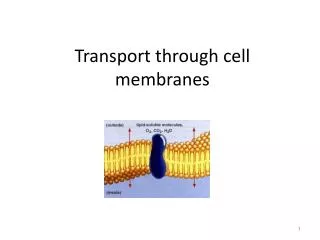
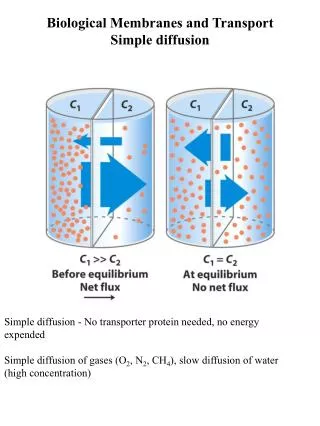
Diffusion • A process that allows ions or molecules to move from a region higher concentration to a region of lower concentration until equilibrium is attained.
Vernier Experiment • A conductivity probe will be used to monitor ions in solution and monitor its concentration over a period of time. • AIM: Study the effect of concentration gradients on the rate of diffusion. Determine if the diffusion rate for a molecule is affected by the presence of a second molecule.
Materials • Computer • Vernier conductivity probe • Logger pro software • Graduated cylinders-3 • 1%, 5% and 10% salt solutions • 400 mL beaker • Dialysis tubing • 5% sucrose solution • Dental floss or clamp • Ring stand and utility clamp
DATA Part I: When dialysis consisting of salt solution is placed in clean water. (Concentration gradients) Part II: When dialysis tubing consisting of salt solution is placed in sucrose solution. (Effect of other molecules)
Part I: Data Part II Data
Part I: Data Part II Data