Exploring Transport Through Cell Membranes: The Science of Diffusion, Osmosis, and Active Transport
This article delves into the essential processes of transport through cell membranes, including diffusion, osmosis, and active transport. It addresses the intriguing questions about skin coverage, molecular movement, and membrane structures. Readers will learn how molecules move from high to low concentration areas, the role of phospholipid membranes, and the significance of facilitated diffusion for larger or charged molecules. Through engaging explanations and links to interactive resources, discover how cells manage their molecular exchanges effectively.

Exploring Transport Through Cell Membranes: The Science of Diffusion, Osmosis, and Active Transport
E N D
Presentation Transcript
Are you covered in skin? Are you REALLY covered in skin? Why do you have openings in your skin?
Molecules are always, always, always, always, always, always, always, always, always, always, always, always, always, always, always, always, always, always, always, always, always, always moving. (So where are they going?)
How do the molecules “know” how to spread out? Are they doing it on purpose? http://concord.org/stem-resources/diffusion-osmosis-and-active-transport
Each individual molecule moves randomly, bumping into whatever is in its path. If all the molecules start out close together, what’s the likelihood of a molecule bumping its way out of the pack compared to randomly staying with everyone else?
Formal Vocabulary • Molecules diffuse from areas of high concentration to areas of low concentration. • They move down a concentration gradient. • This is a passive process. (It happens on its own – we didn’t have to spend any energy to move things around.)
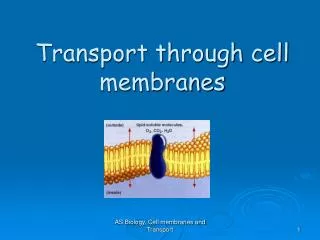
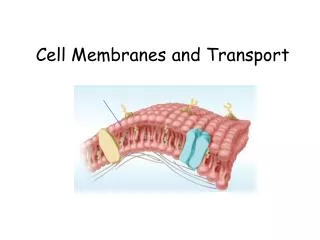
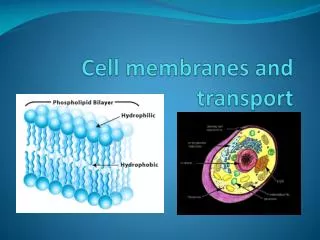
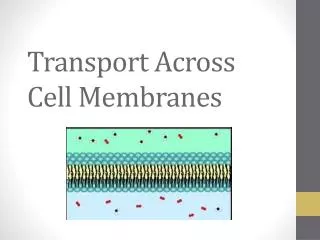
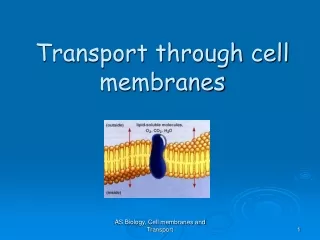
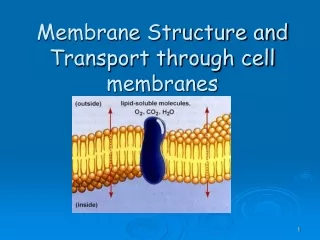
So how do we get things in and out of cells? Can’t forget about that membrane made of phospholipids . . .
I’m a happy nonpolar molecule with equally shared electrons! Crap . . . Lesson: Nonpolar stuff (like lipid tails) hates water.
But what if you’re not polar? O2 – both atoms are equally attractive to electrons CO2 – both sides are equally attractive to electrons
Molecules that diffuse through cell membranes • Oxygen (O2) • Carbon dioxide (CO2) . . . That’s about it. • Everyone else needs a channel.
Facilitated diffusion You need a channel if you’re . . . Charged (ion) Polar Big
Your Very Own Channel! http://phet.colorado.edu/en/simulation/membrane-channels
If there are other molecules dissolved in the water, not all of the water molecules are free to diffuse – some are too busy being attracted to the dissolved stuff.
Osmosis • http://www.concord.org/~btinker/workbench_web/models/osmosis.swf
Big Stuff • What if you want to take in something so large, it won’t fit through a channel? • What if you want to get rid of something so large, it won’t fit through a channel?
Exocytosis AS Biology, Cell membranes and Transport
The Grand Chase http://www.youtube.com/watch?v=JnlULOjUhSQ