Download
1 / 3
40 likes | 155 Vues
This text explores the justification of knowledge claims, delving into the philosophical doctrines of foundationalism and coherentism. Foundationalism posits that knowledge must rest on indubitable foundations, such as self-awareness. In contrast, coherentism asserts that knowledge is justified by consistency within a web of beliefs. The discussion also addresses objections to both theories and the conditions for true belief, including the Gettier problem, which challenges traditional definitions of knowledge. It highlights the complexities of belief justification, particularly through externalism.

E N D
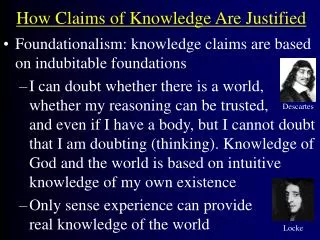
How Claims of Knowledge Are Justified • Foundationalism: knowledge claims are based on indubitable foundations • I can doubt whether there is a world, whether my reasoning can be trusted, and even if I have a body, but I cannot doubt that I am doubting (thinking). Knowledge of God and the world is based on intuitive knowledge of my own existence • Only sense experience can provide real knowledge of the world Descartes Locke
How Claims of Knowledge Are Justified • Coherent: knowledge claims are justified only if they are consistent with other beliefs (including empirical beliefs) that support and complete the whole set of beliefs • Objections: • Against foundationalism: why think that any belief (intuitive or empirical) is justified? • Against coherentism: why think that a belief is true just because it coheres with others?
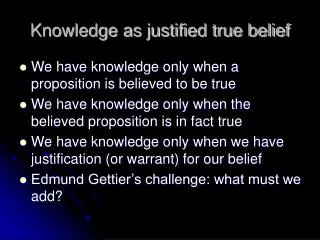
Knowledge and Justified True Belief • Traditionally, “x knows p” means: • x believes that p; p is true; x is justified in believing that p • Gettier problem: all three conditions could hold and still not have knowledge • Externalism (Plantinga): I might be warranted in my belief (if my procedure for getting the information is reliable) without being justified (i.e., I might not know how my belief is based on that procedure) Edmund Gettier