Download
1 / 20
200 likes | 313 Vues
Explore how elements are organized in the periodic table, originally developed by Mendeleev. This foundational tool arranges elements by atomic number, allowing predictions about their properties based on their location. Discover the distinction between metals, nonmetals, and metalloids, as well as details on families such as alkali and alkaline earth metals. Learn about the significance of valence electrons and how they influence the behavior of elements. Access interactive periodic table resources to deepen your understanding.

E N D
Organizing the elements Objective: How are the elements organized?
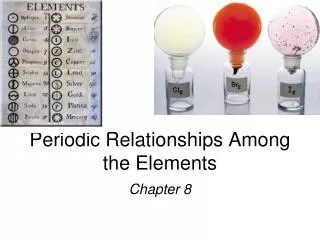
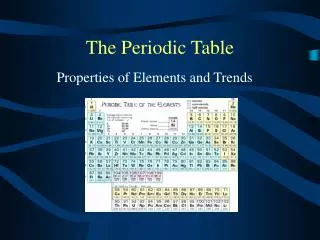
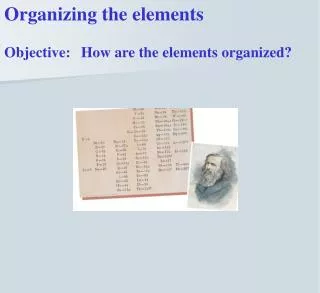
Mendeleev developed the first periodic table of the elements. An element's properties can be predicted from its location in the table. Link to a Periodic Table.
Mg Br Cl C H Fe Ca P Zn The modern periodic table Elements are arranged according to atomic number. Periods (7) = horizontal rows of elements Group (18 family) = vertical column of elements with similar properties Zig zag line = separates metals from nonmetals
http://www.echalk.co.uk/Science/chemistry/periodicTableGame/periodicTable.htmlhttp://www.echalk.co.uk/Science/chemistry/periodicTableGame/periodicTable.html Why the periodic table works? It works because it's based on the structure of the atoms, especially the valence electrons. All the elements in a family all have the same number of valence electrons.
What is a metal? • An element with specific properties: shiny, ductile, malleable, and good conductors of heat and electricity • Usually have 3 or less electrons in outer shell and give up Electrons when forming compounds. • They are found to the left of the zigzag line • Examples: lithium, iron, gold, silver
Review Terms: • Malleable – the ability to be pounded into thin sheets. Ex: aluminum • Ductile – the ability to be pulled into a thin wire. Ex: copper
Alloys • An alloy is a substance that is a mixture of two or more metals. • Examples: bronze (copper with tin) and brass (copper with zinc)
Metals in the periodic table Alkali metals (Group 1) • Are the most reactive • Are never found aselements only in compounds • Are very soft and shiny • 1 valence electron
Alkaline earth metals (Group 2) • Are not as reactive as Group 1 metals • Are fairly hard, gray-white • Good conductors of electricity • 2 valence electrons
Transition metals (Group 3) • Form a bridge between the (left side) very reactive and less reactive (right side) • Are good conductors of electricity • 2 valence electrons
Lanthanides and actinides • Rare earth metals (periods 6 and 7). • Valence electrons: 2 • Lanthanides are soft, malleable, shiny metals with high conductivity • Actinides exist in very small amounts except for thorium and uranium
O O O C N C Cl • What are nonmetals? • An element with properties opposite of metals: often gases or dull, brittle solids with low melting points • Found to the right of the zigzag line • Forms compounds with metals (e.g., NaCl, CO2) • Combines with other nonmetals to form diatomic molecules (e.g., O2, N2, H2)
Properties of Non-Metals (cont.) • Have five or more electrons in their outer shell. • Poor Conductors • They can share or gain electrons when forming compounds.
Families of nonmetals • Carbon family: AKA: tetrels – from Latin tetra (four) • 4 valence electrons
Families of nonmetals • Nitrogen family: AKA: pnictide – from Greek pnigein (to choke) • 5 valence electrons
Families of nonmetals • Oxygen family: AKA: chalcogens – from Greek chalkos (ore) • 6 valence electrons
More families of nonmetals • Halogen family: reactive; found in nature as compounds or diatomic molecules • 7 valence electrons
More families of nonmetals • Noble gases: odorless, colorless gases that are not reactive • 8 valence electrons
More families of nonmetals • Hydrogen: a very reactive nonmetal because it has 1 valence electron. • This is why it is in the column with the alkali metals. • However, it is not classified as an alkali metal.
Metalloids • Have characteristics of both metals and nonmetals • Seven elements on the border between metals • and nonmetals • Great conductors of electricity • Examples: B, Si, As, Te, At, Ge, Sb